
India Tightens Food Safety Checks as Festive Demand Surges
Rising inspections and state crackdowns highlight enforcement gains, but failed samples and weak follow-through remain concerns

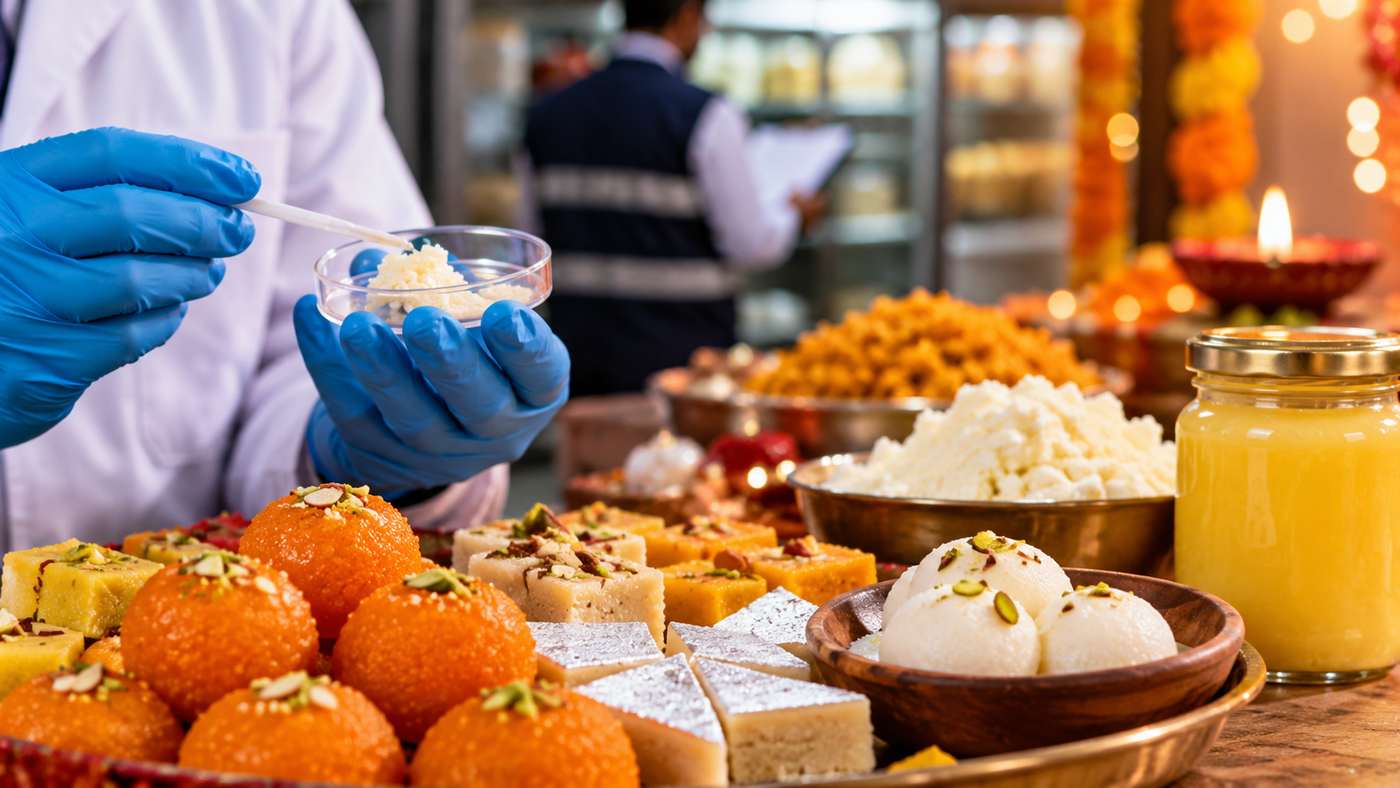
- Food safety inspections rose 46% in two years.
- Over 40,000 samples were non-conforming in 2025-26.
- Maharashtra seized more than 50,000 kg of food products.
- Experts stress daily prevention alongside regulatory inspections.
GG News Bureau
New Delhi, 3rd Oct: India’s food safety enforcement has expanded sharply, with inspections by the Food Safety and Standards Authority of India (FSSAI) and state authorities rising by about 46 per cent over two years. Yet the festive season has once again highlighted concerns over adulteration, enforcement capacity and consumer trust.
Maharashtra Food Commissioner Tukaram Mundhe, who took charge on May 25, has emerged as a prominent face of the state’s intensified food safety enforcement. His department has focused heavily on the milk and dairy supply chain as demand for products such as khoya, paneer, ghee and sweets rises during the festive period.
Government data cited in Parliament shows that FSSAI and state authorities conducted 5,20,566 inspections in 2025-26, compared with 4,01,391 in 2024-25 and 3,57,072 in 2023-24.
Of 2,23,808 samples analysed in 2025-26, 40,023 were found to be non-conforming. The figures for 2025-26 are provisional. The non-conforming category can include adulterated, sub-standard, contaminated and misbranded food.
The available data also shows why the headline numbers require careful interpretation. In 2023-24, of 33,808 non-conforming samples, 22,603 were classified as sub-standard, 6,782 as unsafe and 4,423 as having labelling defects.
This means that most recorded failures that year related to quality or labelling rather than food classified as unsafe. However, the data does not provide a detailed public breakdown of the latest non-conforming samples by category or food product.
Detection and Punishment Gap
Enforcement data also points to a gap between detection and legal outcomes.
Parliamentary data records 31,878 civil cases decided with a penalty and 1,918 criminal convictions in 2025-26. These cases can relate to samples collected in earlier years and therefore cannot be directly compared with the 40,023 non-conforming samples recorded in the same period.
The figures nevertheless underline the complexity of converting regulatory violations into completed legal action.
The festive period remains a particular concern for regulators because demand for sweets, savouries, milk, ghee, khoya and paneer increases significantly. Higher demand can also create greater economic incentives for adulteration.
Maharashtra Intensifies Crackdown
Maharashtra’s recent enforcement campaign illustrates the scale of action being taken ahead of the festive season.
Between September 23 and 27, the state Food and Drug Administration suspended the licences or registrations of 30 establishments and seized more than 50,000 kg of food products valued at Rs 1.19 crore.
The seized products included khoa, paneer, ghee, cream, sweets, shrikhand, lassi, coconut oil, farsan and potato wafers.
In a separate action targeting banned products, authorities registered 22 FIRs, made 30 arrests, sealed three establishments and seized stock worth Rs 30.63 lakh.
The enforcement action has also extended to established businesses. The FDA suspended the licence of Mumbai’s Kyani & Co after finding hygiene violations.
In Malad East, officials seized 2,464 kg of ghee, refined sunflower oil and vanaspati from a dairy where authorities alleged that the products were mixed with branded ghee and sold as “Pooja Ghee”.
Food Safety Is More Than Inspections
The scale of India’s food market means regulators cannot physically monitor every factory, warehouse, vehicle, kitchen and retail outlet.
Umesh Kumar Agarwal, Director at Haldiram, said food safety during the festive period has to extend across the entire supply chain, from sourcing and manufacturing to transportation, storage and retail.
“Inspections matter. They create accountability and act as an external check,” Agarwal said, while stressing that food safety cannot be measured only by the number of inspections or samples collected.
He argued that responsibility must also lie within food businesses, with procurement teams working with approved suppliers, manufacturers following specifications and supply-chain operators maintaining proper storage and temperature controls.
Agarwal also pointed to digital traceability, supplier audits, rapid testing, laboratory checks and real-time temperature monitoring as tools that can help identify problems earlier.
Economic Cost of Unsafe Food
The consequences of unsafe food extend beyond individual medical bills.
The World Bank has estimated that unsafe food costs low- and middle-income economies about $110 billion annually in lost productivity and medical expenses, with India accounting for an estimated $15 billion of that burden.
The costs include medical treatment, lost wages, reduced productivity, lower business and trade revenues and food waste.
The World Health Organization has also estimated a much larger global annual burden from unsafe food, underscoring the scale of the public-health and economic challenge.
For households, the impact can appear through medical expenses, lost working days and reduced productivity. At a national level, these individual costs can accumulate into a wider economic burden.
From Enforcement to Prevention
India’s rising inspection numbers and state-level enforcement drives indicate an expanding regulatory effort. But the challenge extends beyond increasing the number of inspections.
Four issues remain particularly important: clearer public data separating unsafe food from other violations, stronger conversion of detected violations into legal outcomes, more consistent enforcement capacity across states, and rebuilding consumer confidence.
The festive season puts that challenge into sharper focus. Enforcement can detect violations, but sustained food safety ultimately depends on prevention across the entire supply chain.
As Agarwal put it, food safety has to be maintained “every batch, every shift and every day” rather than only when inspectors arrive.
