
VP Radhakrishnan Calls for Inclusive Economic Resilience
Vice-President addresses 5th Kautilya Economic Conclave, stresses inclusion, consensus and responsive policymaking

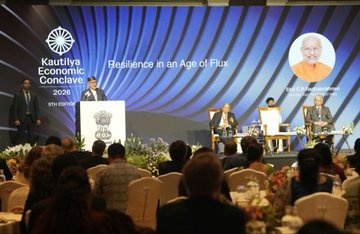
- Radhakrishnan inaugurates the 5th Kautilya Economic Conclave.
- He links economic resilience with social inclusion.
- He highlights financial inclusion and women-led development.
- He stresses consensus and responsive policymaking.
GG News Bureau
New Delhi, 3rd Oct: Vice-President C. P. Radhakrishnan on Saturday called for resilient and inclusive economic policies to help India navigate rapid global changes, saying economic resilience cannot be separated from social resilience.
Addressing the inaugural session of the 5th Kautilya Economic Conclave in New Delhi, organised on the theme “Resilience in an Age of Flux”, Radhakrishnan said policymaking must remain grounded in realities and adapt to changing circumstances.
The Vice-President said decisiveness during periods of uncertainty must be supported by consensus. He stressed that debate and discussion are central to democracy but should ultimately lead to decisions that enjoy broad acceptance.
Radhakrishnan said India has demonstrated that democracy and development can advance together. He linked consensus-building with the durability of economic reforms and said the experience provides an important foundation for the vision of Viksit Bharat by 2047.
Highlighting financial inclusion and formalisation, he cited the role of the JAM trinity, Direct Benefit Transfer and GST. According to the figures cited in his address, more than 590 million Jan Dhan accounts had been opened by August 2026, while GST registrations increased from around 6.65 million in 2017 to 16.5 million in May 2026.
The Vice-President said inclusion should extend beyond bringing people into the formal economy and enable citizens to create value, generate income and become entrepreneurs.
He highlighted the contribution of around 9.2 million Self-Help Groups, covering more than 100 million rural women, and the emergence of more than 34.6 million Lakhpati Didis. He said the growing participation of women in education and the economy reflects a shift from women’s empowerment towards women-led development.
Radhakrishnan said resilience is built not only through financial markets and institutions but also through changes at the grassroots level, including access to banking, direct benefits and opportunities for entrepreneurship.
He also highlighted the reported movement of more than 250 million Indians out of extreme poverty, calling for every State, district and village to be an equal participant in India’s development journey.
The Vice-President called for stronger research and institutional partnerships and welcomed cooperation involving the University of Delhi, Delhi School of Economics, London School of Economics and the Institute of Economic Growth.
Referring to the legacy of the Institute of Economic Growth, established in 1952 under Professor V. K. R. V. Rao, he said sound policymaking should be informed by ground realities and remain responsive to changing circumstances.
Concluding his address, Radhakrishnan said India’s resilience would come “not from resisting change, but from embracing it with confidence, inclusion and a spirit of collective endeavour.”
The event was attended by IEG President and Board of Trustees member N. K. Singh, Chairman of the IEG Board of Governors Dr Michael Debabrata Patra and other dignitaries.
