
Nandigram Bypoll: A Contest Caught in a Political-Legal Storm
Milan Pradhan’s arrest after Mamata’s backing has intensified questions over timing, alliances and the road ahead

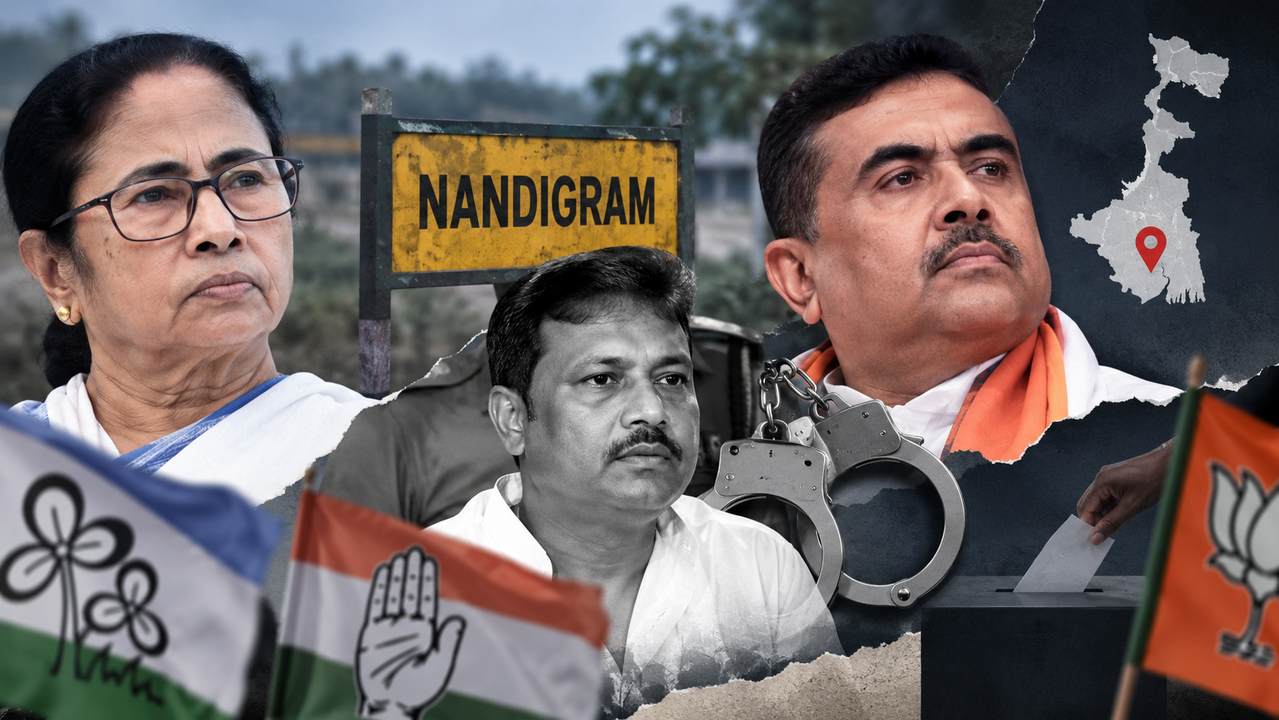

Nandigram has once again become the centre of West Bengal’s political contest, but this time the drama is unfolding even before the ballot is cast. Within hours on Friday, the constituency witnessed a sequence of developments that brought together an internal Trinamool split, a Congress-BJP confrontation, Mamata Banerjee’s decision to back a Congress candidate and the arrest of that candidate in an old case.
The immediate sequence is striking. Sanchita Pradhan Dey, fielded by the Mamata Banerjee-led faction, withdrew from the Nandigram contest after meeting Chief Minister Suvendu Adhikari. Mamata Banerjee subsequently announced support for Congress candidate Milan Pradhan, presenting the move as an effort to strengthen the INDIA bloc. Hours later, Pradhan was arrested in connection with cases linked to the 2007 Nandigram land-acquisition agitation.
The timing has become the central political question. Congress leaders have described the arrest as politically motivated, with Rahul Gandhi calling it “political revenge” and alleging that the electoral contest was being undermined. West Bengal Congress leaders have also questioned why an old case resulted in Pradhan’s arrest precisely when his candidature had received Mamata’s backing.
There is, however, another version of the episode. Ritabrata Banerjee, who heads a rival Trinamool faction contesting the bypoll, has said that his faction itself lodged a complaint against Pradhan and that criminal cases and an existing warrant were involved. That claim places the arrest within an already existing legal process rather than establishing, by itself, a political motive.
This distinction is important. The political timing and the legal basis for the arrest are separate questions. An arrest occurring during an election campaign can generate legitimate political scrutiny over timing, while the existence of an old case or warrant is a separate matter that ultimately has to be established through police and court records. Current reports confirm that Pradhan was arrested in connection with old cases associated with the 2007 Nandigram violence, but details surrounding the specific case leading to Friday’s arrest remain subject to verification.
Nandigram carries unusual political weight because the 2007 anti-land-acquisition movement became a defining chapter in Mamata Banerjee’s political rise. The constituency later became the stage for her direct electoral contest with Suvendu Adhikari, who defeated her there in 2021. Adhikari subsequently won Nandigram again in the 2026 Assembly election before vacating the seat, necessitating the present bypoll.
The current contest is also taking place against the backdrop of a fractured Trinamool political space. The Election Commission has barred the rival factions from using the original All India Trinamool Congress name and its reserved symbol for these bypolls. The Mamata-led faction has been allotted the name “Mamata All India Trinamool Congress” and the “Football Player” symbol, while the rival faction has been allotted “Democratic Trinamool Congress” and the “Envelope” symbol.
That fragmentation matters because the Nandigram contest is no longer simply a conventional BJP-versus-Opposition battle. There are competing Trinamool formations, Congress, the BJP and Left-linked forces in the field, while Mamata’s decision to support Pradhan temporarily altered the Opposition’s electoral arithmetic. The arrest has now complicated that arrangement further.
For Congress, the immediate issue is whether Pradhan’s legal position affects his ability to continue as the party’s candidate and campaign effectively. For Mamata’s faction, the decision to support Congress has created a political commitment that is now intertwined with a legal controversy. For the BJP, the episode has produced an Opposition charge of political interference, while the party and its supporters have rejected the allegation and maintained that law enforcement should proceed according to legal procedure.
The episode also illustrates why Nandigram remains more than an ordinary bypoll. Its political history, the continuing contest between Mamata Banerjee and Suvendu Adhikari, the division within the Trinamool camp and the latest Congress-Trinamool understanding have all converged in one constituency.
What happens next will depend less on the political rhetoric of the competing camps and more on the legal status of Pradhan’s cases, the decisions of the election authorities and whether the Congress-backed candidature can proceed under the applicable electoral rules. Until those questions are settled, the Nandigram bypoll remains a contest defined not only by candidates and parties, but also by a rapidly evolving legal and institutional situation.
