
Needonomics Can Guide Sustainable Financial System in the AI Era: Prof. M. M. Goel

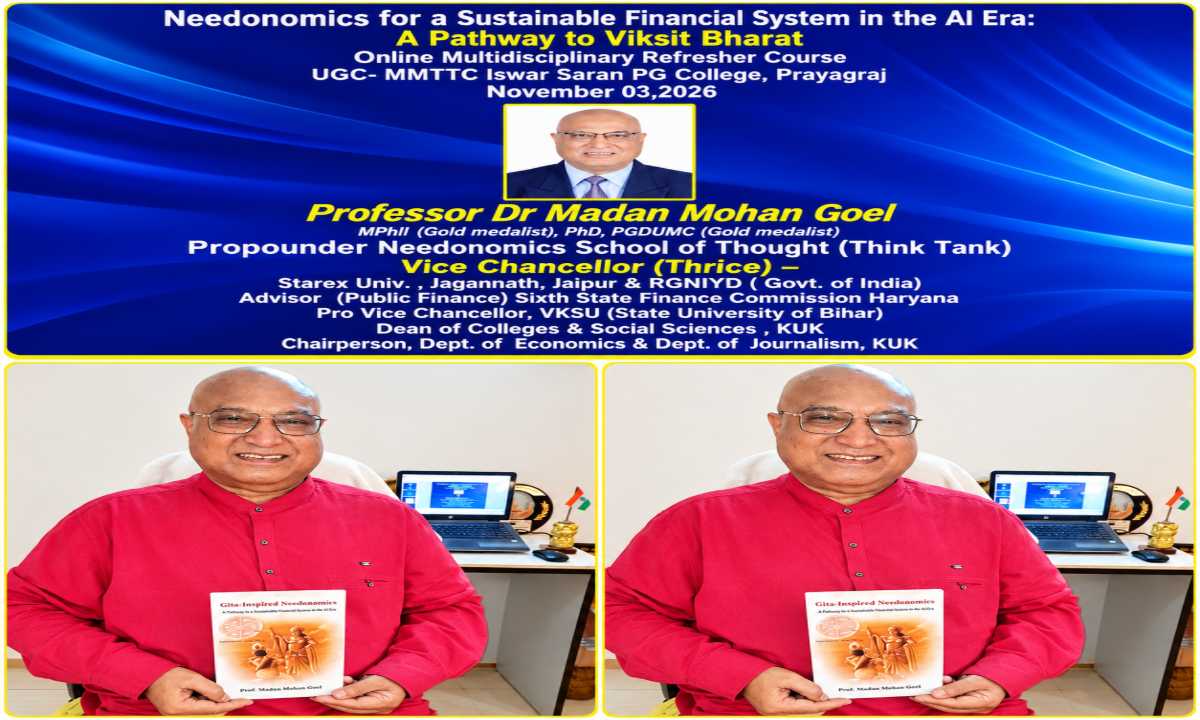
Prayagraj , Nov.03,2026- “Sustainable finance in the Artificial Intelligence (AI) era requires a judicious balance between technological innovation, ethical responsibility and human welfare,” said Prof. Madan Mohan Goel, Propounder Needonomics School of Thought, three-time Vice-Chancellor, and superannuated Professor from Kurukshetra University. Today, he was addressing the participants of online Multidisciplinary Refresher Course on “Relevance of Needonomics for a Sustainable Financial System in the AI Era: A Pathway to Viksit Bharat” organized by the UGC- Malaviya Mission Teacher Training Centre (MMTTC) , Iswar Saran PG College, Prayagraj.
The session was chaired by Prof. Anand Shanker Singh Director-MMTTC /Principal. Dr Shiv Verma programme convener welcomed and introduced Prof. M.M. Goel with a citation in recognition of his contributions.
Prof. Goel highlighted AI’s potential to enhance credit assessment, fraud detection, risk management and financial inclusion, emphasizing that human oversight, transparency, data protection and accountability are essential for fair and sustainable financial stability.
According to Prof. Goel, Needonomics provides a relevant framework for transforming conventional financial thinking towards responsible value creation, prudent lending, responsible consumption, ethical investment and inclusive financial well-being.
He stressed that AI-driven financial services should bridge the urban-rural divide, expand affordable access to banking and credit, and channel investments towards productive enterprises and environmental sustainability.
For India, achieving the vision of Viksit Bharat requires coordinated efforts by policymakers, regulators, financial institutions, technology developers and educational institutions.
Prof. Goel advocated “AI for Efficiency, Ethics for Direction and Needonomics for Sustainable Prosperity.”
Financial progress must be assessed not merely through transaction volumes or digital expansion, but through inclusion, resilience and human well-being, concluded Prof Goel.
