
NITI Aayog Holds National Workshop on SDG Budgeting in Kolkata
Workshop focuses on linking State budgets with SDG targets and measurable development outcomes

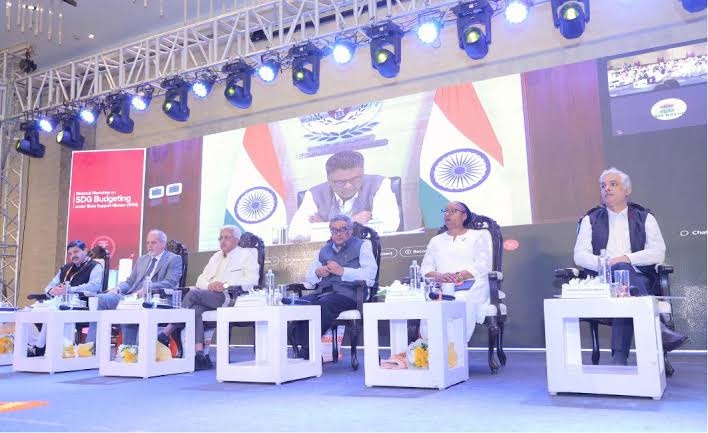
- Representatives from 32 States and Union Territories participated in the workshop.
- West Bengal, Haryana, Odisha and Meghalaya shared their SDG budgeting experiences.
- NITI Aayog, CAG and UNDP discussed a framework for mapping State budgets to SDGs.
- Sessions examined public expenditure, accountability and private-sector participation in SDG implementation.
GG News Bureau
Kolkata, 2nd Oct: NITI Aayog, in collaboration with the Government of West Bengal and with technical support from the United Nations Development Programme (UNDP), organised a National Workshop on SDG Budgeting in Kolkata on September 29 under its State Support Mission (SSM).
The workshop focused on strengthening the alignment of planning and budgeting processes with the Sustainable Development Goals (SDGs), particularly through institutionalising SDG budget tagging and linking financial allocations with measurable development outcomes at the sub-national level.
The workshop brought together senior officials from NITI Aayog, the Comptroller and Auditor General of India (CAG), Ministry of Statistics and Programme Implementation (MoSPI), Controller General of Accounts (CGA), Department of Public Enterprises (DPE), Indian Institute of Corporate Affairs (IICA), UNDP and the UN Resident Coordinator Office, among others.
Representatives from FICCI, CII, SEBI, Tata Steel Foundation, Intellecap and GIZ also participated, reflecting the workshop’s focus on a whole-of-government and whole-of-society approach to SDG localisation.
The inaugural session was attended by West Bengal Finance Minister Dr. Swapan Dasgupta, NITI Aayog Member Dr. R. Balasubramaniam, Comptroller and Auditor General of India Shri K. Sanjay Murthy, Chief Economic Adviser Dr. V. Anantha Nageswaran, West Bengal Additional Chief Secretary (Finance) Shri Prabhat Kumar Mishra, UN Resident Coordinator Shri Stefan Priesner, UNDP Resident Representative Dr. Angela Lusigi and NITI Aayog Programme Director (SDGs) Shri Rajib Kumar Sen.
Dr. Swapan Dasgupta highlighted the importance of establishing a clear connection between development goals, targets, budget allocations and implementing agencies. He described SDG budget tagging as a mechanism to establish that link.
Dr. R. Balasubramaniam said mapping SDGs to State expenditure was an important step and emphasised the need for States to demonstrate how public expenditure translates into effective development outcomes.
Shri Prabhat Kumar Mishra said West Bengal had, for the first time, mapped its budget to the goal level of the SDGs and integrated the exercise into its Integrated Financial Management System.
The discussions also examined the role of the private sector in advancing SDG priorities. Participants discussed policy frameworks, innovative financing, corporate social responsibility, sustainability reporting, ESG frameworks and the Social Stock Exchange.
A key reference point during the workshop was the “Guide on Mapping State Budgets to the SDGs”, developed jointly by NITI Aayog, the CAG of India and UNDP. The framework was discussed as a tool for aligning State budgets with SDG goals and improving the visibility of expenditure against development priorities.
Four technical sessions examined the design and implementation of SDG budget tagging, including identification of expenditure, the appropriate level of tagging, linkage with Heads of Accounts, tagging to SDG targets, NITI Aayog’s Scheme-SDG mapping and value assignment.
States including Haryana, Odisha, Meghalaya and West Bengal shared their experiences in implementing and institutionalising SDG budgeting. Discussions also covered integration of SDG budgeting into annual budget cycles, institutional responsibilities, reconciliation, quality assurance, reporting and performance audit.
A separate session examined private-sector engagement, with participation from organisations and institutions including Tata Steel Foundation, Intellecap, IICA, MoSPI, FICCI, GIZ, ITC Limited, CII and SEBI.
The workshop concluded with an emphasis on strengthening the connection between public expenditure, development priorities and measurable outcomes as India works towards the 2030 SDG milestone and the broader Viksit Bharat@2047 objective.
