
Partition History’s Largest Mass Migrations: VP Radhakrishnan
Vice-President C. P. Radhakrishnan says Partition divided a shared civilisation; urges youth to remember history and uphold national unity

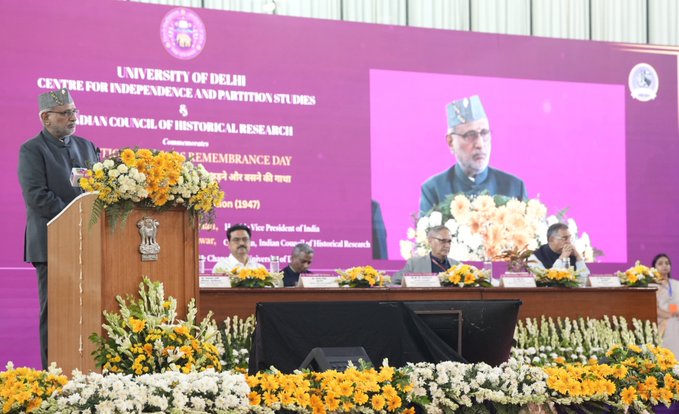
- Vice-President described Partition as one of the largest mass migrations in human history.
- Said Partition divided a civilisational heritage built over thousands of years.
- Urged younger generations to learn the truth of Partition and value national unity.
- Felicitated 15 Partition survivors and administered the ‘No Drugs’ pledge to students.
GG News Bureau
New Delhi, 14th Aug: Vice-President C. P. Radhakrishnan on Friday said the Partition of India witnessed one of the largest mass migrations in human history and warned that its devastating consequences continue to influence the country’s security and regional relations even today.
Addressing a national seminar on Partition Horrors Remembrance Day at the University of Delhi, organised by the Centre for Independence and Partition Studies in association with the Indian Council of Historical Research (ICHR), the Vice-President said the nation must remember the suffering of millions while drawing lessons that strengthen unity and harmony.
Paying tribute to Partition survivors present at the event, he described the division of India as “one of the most tragic and dehumanising chapters” in the country’s history. He said Independence brought freedom from colonial rule but was accompanied by an unprecedented humanitarian tragedy.
The Vice-President emphasised that remembering Partition is not intended to reopen old wounds but to reinforce the importance of peace, unity and national integration. He said the tragedy should serve as a lasting reminder of the consequences of hatred and division.
Highlighting the importance of historical awareness, Shri Radhakrishnan said young Indians deserve to know the truth about Partition, adding that such a defining event cannot be reduced to a few lines in textbooks. He praised the University of Delhi’s Centre for Independence and Partition Studies for documenting oral testimonies of more than 100 Partition survivors and preserving their experiences.
Referring to the long-term impact of Partition, the Vice-President said the hurried redrawing of borders created disputes that continue to affect India’s defence, national security and relations with neighbouring countries. He stressed that decisions affecting the safety and security of citizens must always be taken with careful planning and adequate preparedness.
He further observed that Partition was not merely the division of political boundaries but also the fragmentation of a civilisational landscape that had remained interconnected for thousands of years. He referred to the separation of important cultural and spiritual sites, including the Sindhu river, Kartarpur Sahib, Nankana Sahib, ancient Shaktipeeths and archaeological centres such as Harappa, Mohenjodaro and Takshashila.
Calling upon citizens to place the nation above narrower identities, Shri Radhakrishnan said no caste, religion or region can be more important than the country. He urged every Indian to remain conscious of the nation’s shared civilisational heritage and collective identity.
During the programme, the Vice-President felicitated 15 Partition survivors in recognition of their courage and resilience. He also administered the ‘No Drugs’ pledge to students, encouraging them to adopt healthy and responsible lifestyles.
Concluding his address, Shri Radhakrishnan said Partition Horrors Remembrance Day should remind every citizen that freedom is precious, unity is indispensable and peace can never be taken for granted. The Vice-President also visited an exhibition organised by the ICHR and the University of Delhi, describing it as a powerful reminder of the immense human cost of Partition.
