
“PRAHAAR Must Reach Every Police Station”: HM Amit Shah
Home Minister Launches ‘PRAHAAR’ Counter-Terrorism Strategy; Conference focuses on seven-pillar framework, stronger coordination and faster response to terror threats

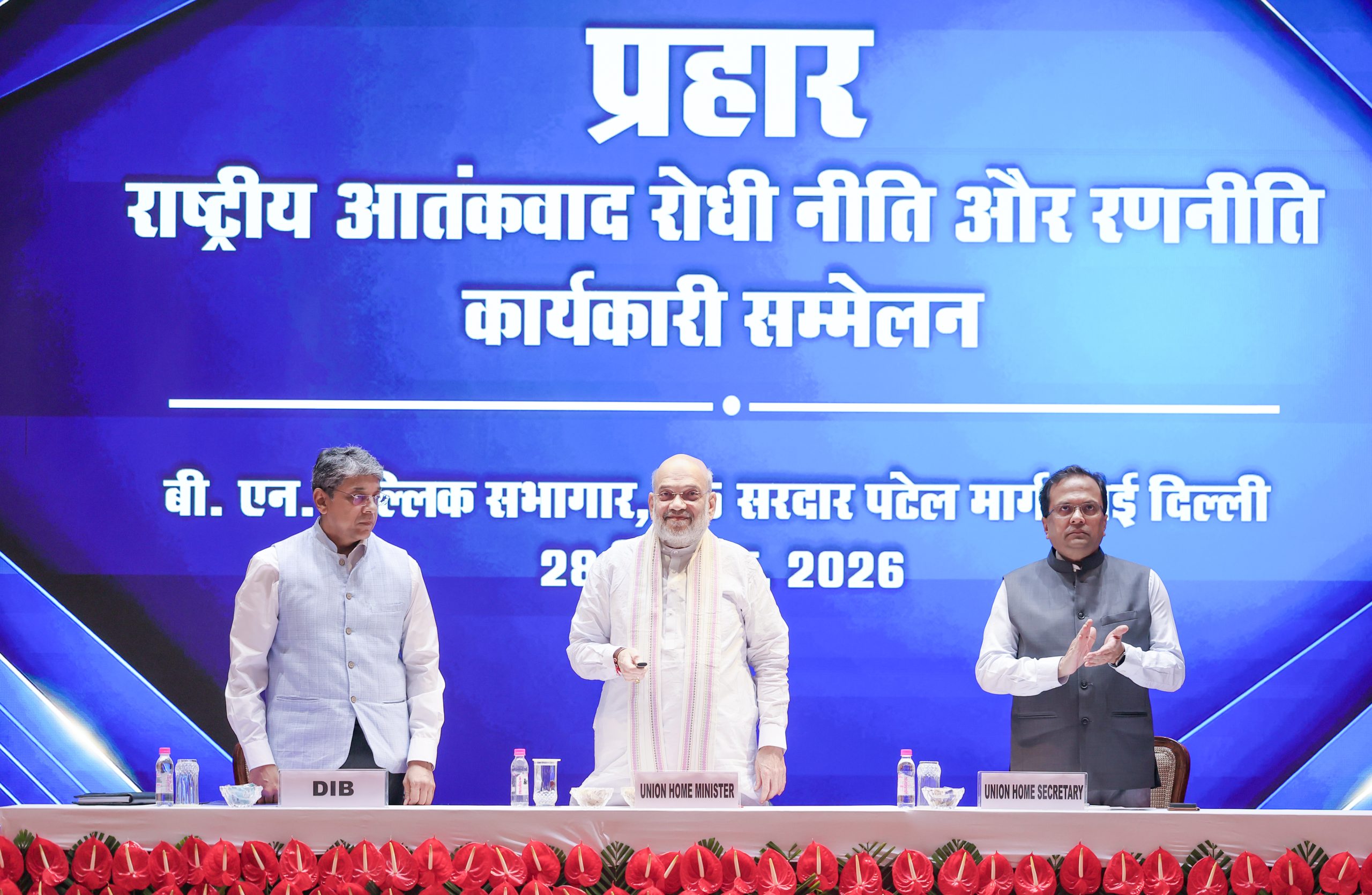
- Amit Shah launches ‘PRAHAAR – CT Policy and Strategy’ conference.
- Seven-pillar framework discussed for strengthening counter-terrorism efforts.
- New Extradition Portal launched to expedite return of fugitives.
- Government cites 288 fugitives brought back from 36 countries since 2019.
GG News Bureau
New Delhi, 29th Sept: Union Home Minister and Minister of Cooperation Amit Shah on Monday inaugurated the conference on ‘PRAHAAR – CT Policy and Strategy’ in New Delhi, bringing together senior security and police officials to deliberate on strengthening India’s counter-terrorism framework.
The conference focused on the seven pillars of the PRAHAAR framework — Prevention, Response, Aggregating Internal Capacities, Human Rights, Attenuating Conditions for Terrorism, Aligning International Efforts, and Recovery & Resilience — through a whole-of-society approach.
The meeting was attended by the Union Home Secretary, Foreign Secretary, heads of CAPFs and Central Police Organisations, Directors General of Police from 15 states, and Anti-Terrorism Squad chiefs from all states and Union Territories. Other state DGPs and frontline police officers participated virtually.
Focus on 10-year counter-terrorism mechanism
Addressing the conference, Shah said the government has adopted a “zero-tolerance” policy towards all forms and manifestations of terrorism under the leadership of Prime Minister Narendra Modi.
He called for continuous analysis of terror incidents to strengthen and improve the PRAHAAR strategy and establish a robust mechanism for the next 10 years.
The Home Minister stressed that the principles of PRAHAAR should reach the police-station level, calling for a proactive approach to every aspect of the framework.
He also advocated institutionalising an automated counter-terrorism response at every level of the PRAHAAR framework to enable faster action against emerging threats.
Shah stresses coordination among agencies
Shah emphasised the need for better coordination among stakeholders to prevent delays and ensure that each pillar of PRAHAAR produces measurable results.
He cited inter-agency coordination in countering the Shahzad Bhatti network, which, according to the government, was involved in cross-border smuggling of weapons, explosives and narcotics.
More than 40 modules of the network were busted, over 100 FIRs registered and 350 people arrested across 15 states, Shah said.
The government also declared the Shahzad Bhatti network a terrorist organisation under the Unlawful Activities (Prevention) Act (UAPA).
New Extradition Portal launched
During the conference, Shah also launched a new Extradition Portal aimed at strengthening coordination and expediting efforts to bring fugitives back to India from abroad.
According to the Home Minister, between 2019 and 2026, the government brought back 288 fugitive criminals from 36 countries.
Shah urged state police forces to establish dedicated teams that can work closely with central agencies to facilitate the return of fugitives from foreign jurisdictions.
The new portal is intended to bring greater coordination to extradition-related efforts and facilitate the exchange and processing of information among agencies.
Seven pillars of PRAHAAR
The conference’s discussions centred on the seven pillars of the framework:
- Prevention — addressing terrorist threats before attacks occur.
- Response — strengthening mechanisms for timely action.
- Aggregating Internal Capacities — bringing institutional capabilities together.
- Human Rights — incorporating rights-based considerations.
- Attenuating Conditions for Terrorism — addressing factors that enable terrorism.
- Aligning International Efforts — strengthening international cooperation.
- Recovery & Resilience — improving recovery mechanisms and societal resilience.
Shah called for the framework to be implemented through coordinated action across security agencies and down to the police-station level.
