
Rajnath Singh Calls for Faster Defence Technology Development
Defence Minister calls for integrated civil-military aerospace ecosystem and stronger public-private synergy

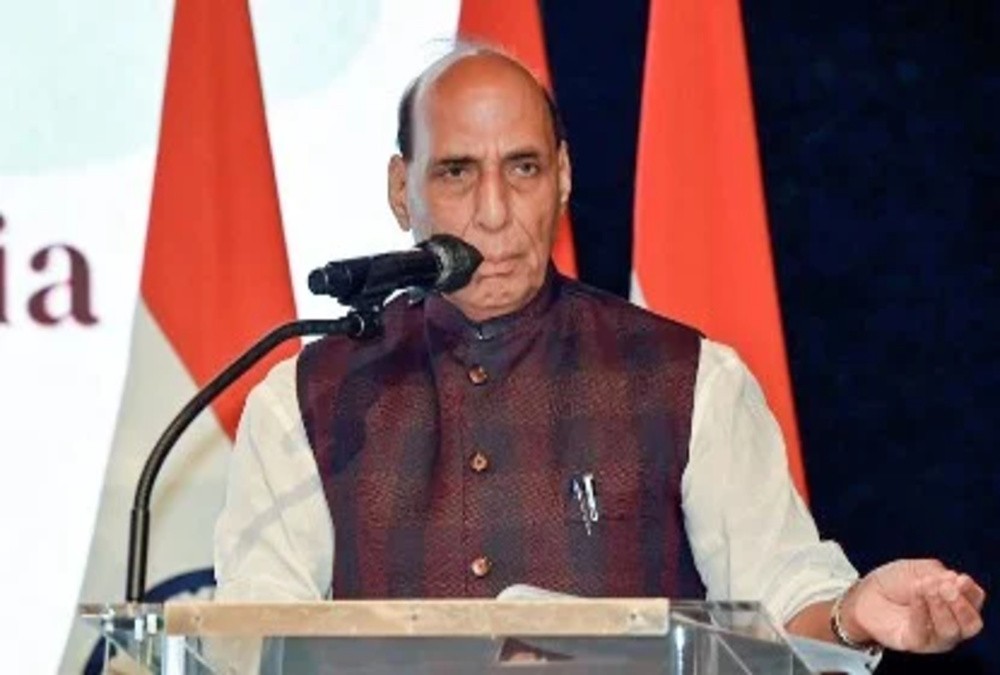
- Singh called for realistic timelines for defence technology projects.
- He urged stronger public-private synergy in aerospace development.
- AI, autonomous systems, cyber technologies and advanced propulsion identified as key areas.
- HAL handed over Tejas trainers, HTT-40 aircraft and Dhruv-NG helicopters.
GG News Bureau
Bengaluru, 19th Sept: Defence Minister Rajnath Singh called for an integrated aerospace ecosystem catering to both civil and military aviation, while cautioning that delays in defence technology projects could create capability gaps, increase costs and risk technological obsolescence.
Singh was speaking at a ceremony in Bengaluru where Hindustan Aeronautics Limited (HAL) handed over two Light Combat Aircraft (LCA) Tejas Final Operational Clearance (FOC) twin-seater trainers and three HTT-40 basic trainer aircraft to the Indian Air Force, along with four Dhruv Next Generation helicopters to Pawan Hans Limited.
Addressing delays in defence technology projects, Singh said they needed to be taken seriously as projects could lose relevance if better technologies emerged elsewhere before development and production were completed. He called for realistic project timelines to reduce capability gaps, cost escalation and the risk of technology becoming obsolete.
The Defence Minister said India needed an ecosystem capable of meeting the requirements of both civil and military aviation. He said capabilities developed domestically in aircraft design, avionics, propulsion, composite materials, flight-control systems, manufacturing and certification could benefit the wider aerospace sector.
Singh also called for greater cooperation between the public and private sectors, saying they should complement rather than compete with each other. He urged the industry to prepare for changes driven by artificial intelligence, autonomous and unmanned systems, electronic warfare, cyber technologies and next-generation propulsion.
Emphasising indigenous research and development, Singh called on scientists, engineers, designers, test pilots and technicians to develop technologies that do not currently exist and build capabilities that can strengthen India’s position in the global aerospace technology landscape over the next decade.
The Defence Minister described the handover of the aircraft and helicopters as a milestone in India’s efforts to build indigenous aerospace capabilities. He said self-reliance in aerospace would require sustained and systematic development rather than a sudden transformation.
“There can be no sudden ‘big bang’ in the development of aerospace systems,” Singh said, describing aerospace development as a gradual process involving multiple components and capabilities.
On the platforms handed over at the ceremony, Singh said the LCA FOC Trainer would support pilot training for frontline fighter operations, while the Dhruv-NG represented India’s indigenous civil aerospace capability. He said the HTT-40 marked a shift from dependence on imported aircraft for basic training towards indigenous production for the Indian Air Force.
Civil Aviation Minister K Rammohan Naidu said the certification and induction of the Dhruv-NG into civil operations marked an important milestone for India’s indigenous civil aviation ecosystem. HAL CMD Ravi K said the handover demonstrated the company’s ability to develop and deliver platforms for both civil and defence requirements.
Singh said future air operations would be increasingly information-intensive and technology-driven, requiring a combination of trained personnel, advanced technology, integrated systems and rapid decision-making.
