
Rajnath Singh Pushes Defence Self-Reliance, Innovation
At Delhi Defence Dialogue, Defence Minister calls for indigenous capabilities, global partnerships and stronger defence exports

- Rajnath Singh stresses indigenous production and independent defence capabilities.
- Defence production reaches ₹1.78 lakh crore in FY 2025–26.
- India targets ₹3 lakh crore in production and ₹50,000 crore in exports by 2029.
- Minister calls for co-development, co-production and greater research freedom.
GG News Bureau
New Delhi, 3rd Nov: Defence Minister Rajnath Singh on Tuesday stressed that defence self-reliance and the ability to independently sustain critical military technologies are essential for India’s preparedness in the changing security environment.
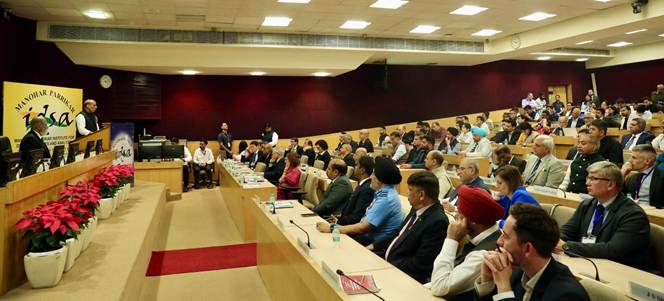
Addressing the third edition of the Delhi Defence Dialogue 2026 at the Manohar Parrikar Institute for Defence Studies and Analyses (MP-IDSA), Singh said military preparedness in the 21st century was closely linked to technological and industrial strength.
He said genuine self-reliance goes beyond manufacturing equipment within the country. It requires the ability to design defence platforms, develop technologies, own intellectual property, improve systems and maintain them throughout their lifecycle without excessive dependence on external suppliers.
Speaking on the theme of defence reforms, self-reliance, collaborations and exports, Singh described these as interconnected pillars of India’s ambition to become a developed nation by 2047.
He said reforms must create an enabling environment, indigenous capabilities must strengthen technological sovereignty, international partnerships should accelerate access to advanced technologies, and exports must improve the scale and competitiveness of India’s defence industry.
Highlighting lessons from recent global conflicts, Singh said the nature of warfare was rapidly changing, with military operations extending into space, cyberspace and digital domains. The growing use of relatively inexpensive drones and autonomous systems has also challenged sophisticated and costly military platforms.
He emphasised that the ability to innovate quickly, manufacture at scale and replenish military resources was becoming as important as possessing advanced weapons systems.
The minister outlined steps taken over the past decade to strengthen India’s defence manufacturing ecosystem, including the establishment of defence industrial corridors and the corporatisation of the former Ordnance Factory Board into seven Defence Public Sector Undertakings.
He also called for greater participation by private companies, MSMEs, start-ups and academic institutions in developing advanced defence technologies. Opportunities in programmes such as the Advanced Medium Combat Aircraft, propulsion systems, ATAGS, artillery ammunition and shipbuilding could accelerate indigenous manufacturing, he said.
Referring to the outcomes of the Ministry of Defence’s Year of Reforms in 2025, Singh said defence production had reached a record approximately ₹1.78 lakh crore in FY 2025–26, while defence exports rose to ₹38,424 crore. Indian defence products are now reaching more than 80 countries, he added.
Singh reiterated the government’s targets of achieving ₹3 lakh crore in defence production and ₹50,000 crore in defence exports by 2029. He urged the industry to improve manufacturing capacity, product quality and global competitiveness.
He also called for expanding defence exports beyond equipment to include maintenance, repair, training, logistics and technology cooperation, saying successful exports should lead to long-term strategic partnerships.
On research and development, Singh said the armed forces must remain closely involved in identifying operational requirements. However, he cautioned against restricting research only to immediate military needs.
He argued that researchers should have the freedom to question established assumptions, explore unconventional ideas and develop technologies whose applications may not be immediately apparent. A balance between operational requirements and research independence, he said, was essential to drive innovation.
Addressing international partnerships, Singh clarified that self-reliance did not mean withdrawing from global engagement. Instead, it would position India as a stronger partner in co-development, co-production and shared innovation.
He called for partnerships that provide meaningful Indian participation in design and development, access to critical technologies, appropriate intellectual property sharing and opportunities for Indian companies in global supply chains.
The minister concluded by urging the armed forces, government institutions, scientists, industry, academia and international partners to work together to move India from procuring defence technologies to creating them and from domestic manufacturing to global competitiveness.
The two-day Delhi Defence Dialogue, being held on November 3 and 4, brings together policymakers, military representatives, industry leaders, academics and strategic experts to discuss defence preparedness, indigenous capabilities and international cooperation.
