

By Anjali Sharma
UNITED NATIONS – The regional director with UN field operations office UNOPS in Nepal Sara Netzer on Friday said that the catastrophic flooding that swept away entire villages in northern Nepal could occur again in the country or elsewhere in the Himalayas due to climate change.
Sara Netzer said that the agency provides infrastructure, procurement and project management services across the world.
She told how UNOPS and partners have been supporting the response, and the difficulties of building back after devastation.
“As we think about reconstruction, normally two to three weeks after a disaster, we would start to see communities rebuilding,” she said.
“But that can’t be the case in these communities in Nepal.”
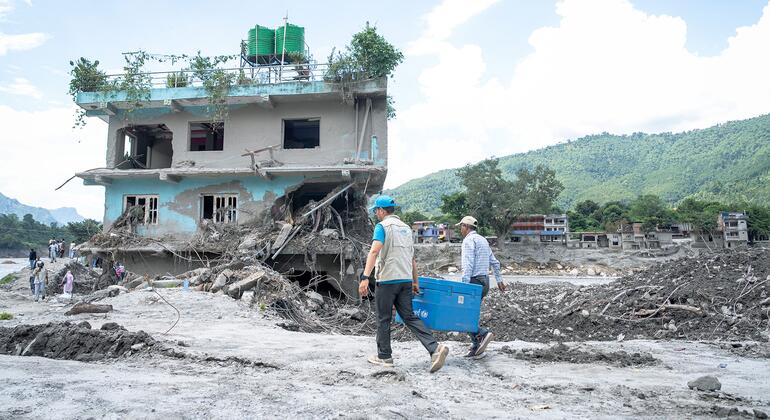
The flash floods and landslides triggered by a glacier collapse in late August killed more than 1,200 people. Homes were moved wholesale up to 150 metres from where they once stood.
Ms. Netzer described some of the hardest hit areas, including one community of some 400 homes, and 1,200 people, where “everything was completely obliterated” by a wall of water and mud.
“It looks like an apocalypse,” she stressed, adding that the debris left behind is between five and eight metres deep.
“The debris has everything you can imagine you can see in it,” she continued. “Eyeglasses, schoolbooks, shoes, blankets and, sadly also likely the remains of loved ones as well.”
Ms. Netzer said that displaced people are now living in what the Nepali government calls holding centres.
The UNOPS team visited some of these locations, where adequate water and sanitation are urgent needs.
UNOPS said many of the displaced are essentially living in schools which the authorities would like to reopen, emergency temporary shelter is also an urgent requirement.
“This is particularly important for children who have experienced this tremendous trauma of seeing loved ones washed away in front of their eyes,” she said.
“Many of them now do not have parents, and they’re also in these holding centres, so as soon as they can return to some sense of normalcy and return to school, that would be beneficial for them.”
The prospects for reconstruction appear less optimistic because “the river has completely changed its course, so it’s not even clear where it is safe for these communities to rebuild and to return”, she added.
She described the land underfoot as uneven and “very much like Jell-O”, saying it “hasn’t even settled yet to begin to think about rebuilding and reconstruction.”
UNOPS has mobilized funding to support urgent engineering assessments, risk mapping of infrastructure and bridge safety analysis.
World Food Programme rely on helicopters to deliver lifesaving aid.
The issue of access across waterways is crucial as only one of the 40 bridges in the area is still standing, leaving communities completely cut off. This has also affected humanitarian operations.
“Overall, it’s a crisis with tremendous human costs, tremendous costs in terms of infrastructure,” she said.
Ms. Netzer recalled that some of the affected communities had already been displaced by the disastrous earthquake a decade ago. People who spoke to the UNOPS team expressed concern over rebuilding and the psychological impacts they face.
These people “have lost everything”, she said, including loved ones, some of whom were breadwinners in the family. Many relatives are also still missing.
“I think what we’re seeing in Nepal is something that could be repeated across the Himalayas as we look at climate change going forward,” she said.
She concluded “It’s a crisis that maybe today is affecting Nepal but has the likelihood of affecting another community or another country going forward.”
