
VHP Hits Back at Vivek Agnihotri Over ‘Tax Religion’ Remark
Vinod Bansal questions filmmaker’s remarks on Kainchi Dham and urges him to withdraw the statement and apologise

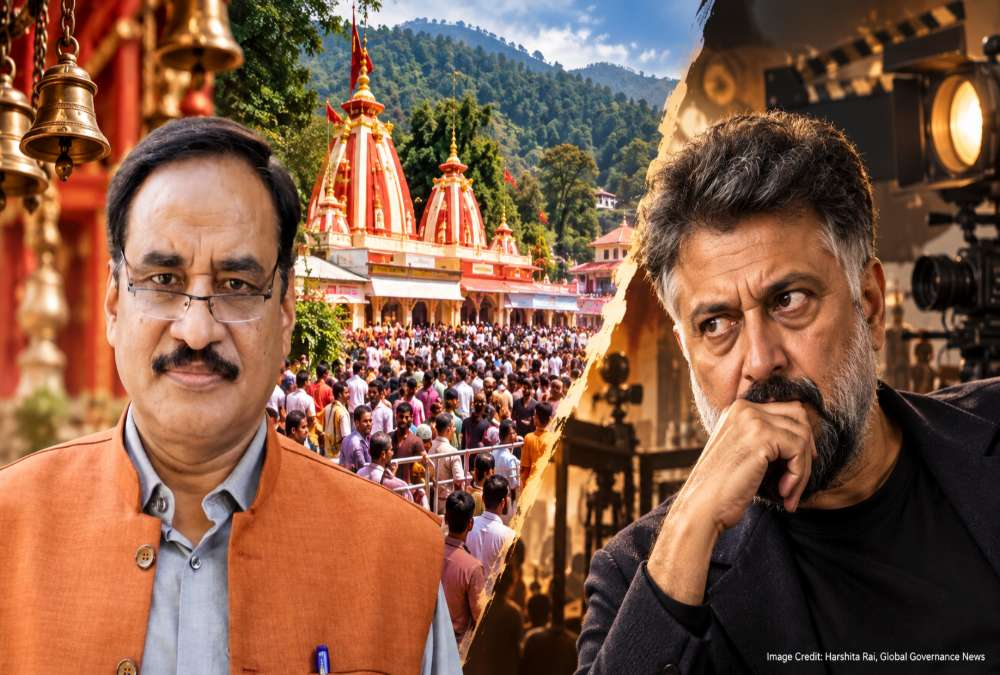
- VHP responds to Agnihotri’s “tax religion” remark.
- Bansal questions linking faith with lack of progress.
- Agnihotri’s later comments trigger a fresh response.
- VHP urges greater understanding before discussing religion.
GG News Bureau
New Delhi, 8th Oct: A war of words has erupted between filmmaker Vivek Agnihotri and the Vishva Hindu Parishad (VHP) after Agnihotri’s remarks on religion, innovation and the large gathering of devotees at Uttarakhand’s Kainchi Dham drew a sharp response from VHP national spokesperson Vinod Bansal.
The controversy began on October 4, when Agnihotri shared a video showing a large crowd at Kainchi Dham and wrote on X that if the government could “tax religion”, India would become the richest country in the world overnight.
Agnihotri argued that this would not be because people would pay the tax, but because they would move away from religion and focus instead on “innovation, progress, productivity and ideas”, rather than waiting for miracles or divine intervention.
Bansal slammed the filmmaker’s remarks, questioning why the pilgrimages of millions of Hindus should be described as waiting for miracles and why religion should be presented as being in opposition to innovation and productivity.
“Pilgrimage sites are the soul of India. They are not merely places of worship; they are deeply connected with our civilisation, culture, social life and local economies,” Bansal said in his response.
He also questioned Agnihotri’s reference to a “religion tax”, pointing out that the film industry has sought tax exemptions for films and asking why such a concept should be raised in the context of religious sites.
Bansal further questioned whether the remarks could have been connected to the promotion of a new film and reminded Agnihotri that the same faith-oriented audience had supported his films and contributed to his success.
He urged the filmmaker to reconsider his words, withdraw the statement and apologise, citing the sentiments of millions of devotees.
The controversy escalated after Agnihotri subsequently responded to the criticism by saying that people should not “share knowledge” about Hinduism because everyone was already knowledgeable. He also distinguished Hindu philosophy from what he described as superstition, miracles and unscientific interpretations.
Responding to this, Bansal said Agnihotri’s observation should apply equally to people from the film industry.
Bansal also questioned why Agnihotri’s comments on superstition and unscientific practices appeared focused on Hinduism, asking whether similar practices were visible at other religious institutions and gatherings as well.
He referred to accounts of people who, according to him, had suffered because of such practices and urged Agnihotri to examine the wider issue before making generalisations about faith.
Bansal also agreed with Agnihotri’s observation that there is “no cure for delusion”, but added that a person should first examine themselves before making such remarks about others.
He concluded by saying that people should not overstep their boundaries and that anyone speaking about religion should first acquire a proper understanding of its traditions and philosophy from respected saints and scholars.
