
VIPASSANA MEDITATION CENTERS IN INDIA
Factual Analysis: Doctrinal Content & Hindu Identity Concerns Confidential Briefing for Hindu Religious Leadership | May 2026

Over the past 18-24 months, multiple complaints have been received from Hindu practitioners on overtly anti-Hindu theological content presented at Vipassana meditation centers, including systematic dismissal of deity worship, derogatory treatment of Vedic mantras and rituals, and positioning of Buddhism as the exclusive path to liberation while explicitly critiquing Hindu spiritual practices.
There is compelling reason to believe that the growing anti-Hindu content in Vipassana discourses is not accidental drift but a deliberate, planned, and strategically calibrated campaign. Participants who attended courses in the 1980s and 1990s consistently report that sessions were predominantly secular in orientation — focusing almost exclusively on meditation technique, breath awareness, and stress relief with minimal theological commentary.. It is only gradually — through the
2000s and accelerating post-2010 — that explicit Hindu-critical content has crept into the narrative, introduced in carefully measured small dosages designed not to trigger immediate alarm or walkout but to slowly, systematically recondition the participant’s relationship with their own tradition.
This incremental strategy is deliberate and sophisticated: like a slow-acting poison introduced drop by drop into clean water, the theological displacement is engineered to be imperceptible in any single sitting but devastating in cumulative effect over years of sustained exposure. This mirrors precisely the Macaulay model of colonial education — where the objective was never sudden, violent rupture from Indian tradition but the gradual creation of a class of Indians who were, in Macaulay’s own words, “Indian in blood and colour but English in tastes, opinions, morals, and intellect.”
The Vipassana model appears designed to produce a parallel outcome: practitioners who remain Hindu in name and family identity but Buddhist in philosophical framework, meditation practice, and spiritual loyalty. Whether coordinated through external ideological networks, funded by organized anti Hindu interests, or representing a calculated institutional strategy, the pattern demands urgent recognition and decisive response from Hindu leadership before what is today a manageable doctrinal influence becomes — as it has in multiple countries — an irreversible civilizational displacement.
METHODOLOGY & REPORTING
In response to these widespread concerns, a senior devotee from our organization was asked to register as a participant and attend a 10-day Vipassana residential course with the specific objective of observing the actual content, structure, and messaging delivered during the program.
Over the course of the 10-day intensive, this devotee documented the meditation techniques, evening discourse content, volunteer protocols, and the theological framework presented to participants. Based on this firsthand participant observation combined with interviews with other Hindu practitioners who had completed Vipassana courses, corroborated reports from multiple sources, and organizational research into Vipassana’s doctrinal foundations and growth patterns, this comprehensive organizational briefing has been prepared to provide Hindu leadership with accurate, factual information regarding the actual content and implications of Vipassana programs operating in India.
This report is intended to inform institutional decision-making regarding appropriate Hindu organizational responses to this phenomenon.
OVERVIEW
Vipassana meditation centers operate across India teaching standardized 10-day residential courses based on S.N. Goenka’s (1924-2013) recorded instructions. With 393 centers worldwide and an estimated 500,000-1,000,000 Hindus having completed courses since 1969, this represents significant engagement of Hindu practitioners with explicitly Buddhist doctrinal content.
Key Concern: While presented as ‘non-sectarian’ and ‘universal,’ participant testimonials and course content analysis reveal systematic Buddhist theological framework with explicit critique of Hindu beliefs and practices.
I. COURSE STRUCTURE & ISOLATION PROTOCOL
● 10 days of complete silence: No speaking, gestures, eye contact, or communication
● Visual isolation: Participants face walls while eating; avoid looking at others
● No external contact: Phones, books, writing materials, religious objects prohibited
● Rigorous schedule: 4AM wake-up; 10-11 hours daily meditation; Sattvic vegetarian meals
● Evening discourse (7-8:30 PM): Pre-recorded S.N. Goenka video presenting Buddhist
doctrine. Looks AI and modified to fit current trends.
● Volunteers instructed NOT to discuss content; questions only to teacher or recordings only
II. BUDDHIST DOCTRINAL CONTENT
A. Explicitly Buddhist Framework
● Pali chanting: Buddham Saranam Gacchami (I take refuge in Buddha), Dhammam Saranam
Gacchami, Sangham Saranam Gacchami
● Buddhist terminology exclusively: Noble Eightfold Path, Four Noble Truths, anicca-dukkha
anatta, nibbana
● Buddha presented as discoverer of ‘the only path to liberation’
● Buddhist cosmology: Rebirth, karma, sankharas as mechanism of suffering
B. Systematic Critique of Hindu Practices
Participants consistently report the following content in evening discourses:
• Deity worship dismissed: Worship of Rama, Krishna, Durga characterized as ‘external ritual’
providing no actual liberation; seeking help from ‘outside’ rather than working internally
• Mantras & rituals rejected: Vedic mantras, bhajans, kirtan described as ‘rites and rituals’ without
experiential basis or purifying effect
• Hindu philosophy contradicted: Buddhist anatta (no-self) positioned as truth versus Hindu atman
(eternal soul) as illusion; Vedanta dismissed as metaphysical speculation
• Brahminism targeted: Specific criticism of ‘Brahmin priesthood,’ caste system, ritual authority;
Buddha presented as revolutionary who rejected these Hindu systems
• Hindu yoga deemed insufficient: Asanas = mere physical exercise; pranayama = breath control
without wisdom; bhakti = emotional attachment; jnana = intellectual speculation; all contrasted with
Vipassana as ‘direct truth’
• Explicit superiority claim: ‘Buddhism is the one and only way to moksha; other paths provide
temporary relief but cannot eradicate suffering at root’
III. HISTORICAL CONTEXT & STRATEGIC APPROACH
S.N. Goenka (Hindu Marwari from Burma) trained under U Ba Khin 1955-1969; returned to India
1969 with strategic approach:
● Present as ‘non-sectarian’ and ‘universal’ rather than explicitly Buddhist
● Emphasize ‘scientific, experiential’ basis rather than faith
● Frame Buddha as rediscoverer of ‘ancient Indian wisdom’ to attract Hindus
● Standardized model via recorded discourses allows rapid scaling without dilution
Analysis: The ‘non-sectarian’ label functions as strategic camouflage allowing Buddhist doctrine to be absorbed by Hindus who would resist explicit conversion. This represents ‘soft’ Buddhist re entry into Hindu cultural space potentially more effective than direct conversion because it operates beneath institutional awareness.
IV. SCALE OF HINDU PARTICIPATION
● 70-80% of Indian course participants are Hindu (Jains, Christians, Muslims ~5-10%; Ambedkarite Buddhists ~10%)
● 25+ centers in India running ~300 courses annually = 15,000-30,000 new participants per year
● Over 50+ years (1969-2026): estimated 500,000-1,000,000 Hindus completed at least one 10-day course
● Long-term practitioners: 50,000-100,000 seriously committed, many effectively identifying as Buddhist
● Primary function: Absorbing Hindu practitioners (especially educated, spiritually-seeking demographic) into Buddhist doctrinal framework.
STRATEGIC DEMOGRAOHIC TARGETING: A Two-Pronged Assault
What makes this phenomenon particularly alarming when viewed alongside broader conversion activity in India is the unmistakable evidence of demographic segmentation — a sophisticated, two pronged strategy that leaves no stratum of Hindu society untargeted.
The economically vulnerable — Dalits, tribals, rural poor, those desperate for livelihood, education, and healthcare — are the primary targets of Christian missionary networks that deploy hospitals, schools, employment opportunities, and financial inducements as conversion instruments. These communities are approached at their point of maximum vulnerability and minimum spiritual resilience.
The upper and upper-middle class Hindu — educated, economically secure, professionally successful, intellectually restless, spiritually seeking — is precisely the demographic that would never respond to material inducement and would immediately reject overt proselytization.
For this “creamy layer,” Vipassana presents the perfect vehicle: intellectually sophisticated, scientifically framed, aesthetically refined, experientially compelling, and carrying no visible religious label that would trigger a defensive response.
By targeting this demographic specifically — corporate executives, doctors, engineers, academics, bureaucrats — the Vipassana influence strikes at precisely those Hindus who lead institutions, shape opinion, influence policy, fund religious organizations, and provide intellectual and financial leadership to the community.
Together, these two instruments — Christian missionary at the base and Vipassana at the apex — constitute a comprehensive and complementary assault on Hindu civilization across its entire social spectrum.
V. RECOMMENDATIONS FOR HINDU ORGANIZATIONS
● 1. Immediate Awareness: Educate Hindu communities about Buddhist doctrinal content in Vipassana courses through temple announcements, articles, youth programs; distribute factual analysis to religious leadership.
● 2. Develop Hindu Alternatives: Create structured residential meditation retreats based on Hindu yogic traditions (Raja Yoga, Dhyana Yoga, Japa Sadhana) providing comparable intensive experience without Buddhist framework.
● 3. Articulate Hindu Meditation Clearly: Most Hindus unaware of sophisticated meditation systems in our own tradition; create accessible presentations of Patanjali’s Yoga Sutras, Upanishadic meditation, Bhakti dhyana practices.
● 4. Train Hindu Teachers: Goenka succeeded through standardized, scalable teaching model; Hindu organizations must train qualified meditation instructors who can guide serious practitioners.
● 5. Philosophical Response: Prepare systematic counter-arguments to Buddhist critiques; explain why anatta (no-self) contradicts Hindu atman; demonstrate depth of Vedantic philosophy versus Buddhist alternatives.
● 6. Strengthen Household Transmission: Youth must have foundational understanding of Hindu philosophical positions before encountering Buddhist alternatives; establish rigorous Hindu study programs.
BOTTOM LINE: Vipassana’s success demonstrates massive demand for serious Hindu meditation training our institutions are not providing. The solution is not critique but creation: building superior offerings rooted in our own profound contemplative traditions.
Many hindu institutions have the infrastructure, teaching capacity, and spiritual depth to lead this response.
FOUR POINT INSTITUTIONAL ACTION PLAN:
Scriptural Literacy Programs — Educate practitioners on the purpose and mechanism behind daily rituals; transform habit into conscious sadhana.
Experiential Retreats — Design programs where participants experience Hindu practice at depth and emerge with personal testimony of its transformative power.
Trained Communicators — Develop teachers who can articulate Hindu philosophy and ritual science in the language contemporary educated Hindus actually speak.
Sustained Community Structures — Build community support systems holding practitioners within their tradition during difficult periods when spiritual progress feels slow and alternatives appear attractive.
VI. CONCLUSION
● Vipassana centers represent large-scale transmission of Buddhist doctrine to Hindu practitioners under ‘non-sectarian’ cover. The 10-day structure combining isolation, intensive practice, controlled information flow, and systematic anti-Hindu discourse constitutes effective doctrinal conversion mechanism operating beneath Hindu institutional awareness.
● With hundreds of thousands of Hindus exposed to this content over five decades, this represents significant erosion of Hindu identity among the very demographic (educated, spiritually-seeking) most crucial for civilizational continuity.
● The appropriate response is not suppression but transparent education combined with development of superior Hindu alternatives. Vipassana succeeds because shows some polished and creamy layer alternative to very mundane Hindu practices.
● The Vipassana phenomenon is both warning and opportunity: warning that Hindu spiritual infrastructure is inadequate; opportunity to rebuild it stronger than ever.
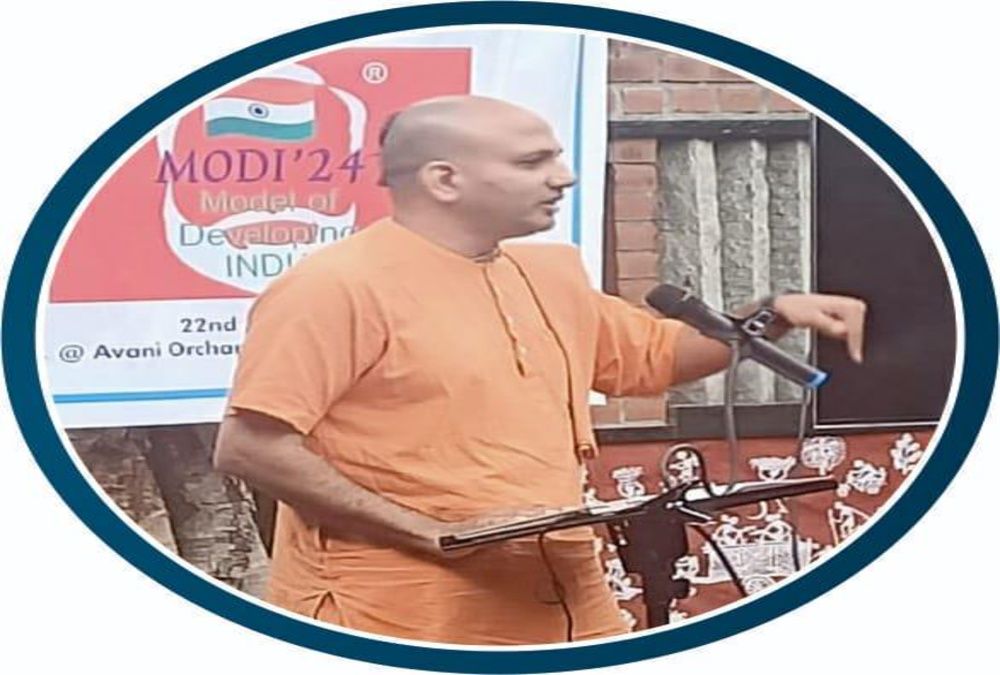
Swami Sriram Charana Aravinda Dasa
ISKCON Spiritual leader and a great motivational authority through speeches, books and articles. An IIM alumni who served as a senior International Banker for various MNC banks, travelled more than 70 countries across the globe and later became a monk. Pioneered the World’s first and the only self-sufficient temple complex at ISKCON Salem, Tamilnadu- where traditional temple economics is put to practice. Member of various Think-tank forums and policy
advocacy groups. Overseeing ISKCON Srilankan operations and executive board member of many temples.
