
Lecture on India’s Diverse Yoga Traditions Held Under ‘Namoolam Likhyate Kinchit’ Series
Scholars Highlight Yoga’s Ancient Roots and Continuing Relevance in Indian Civilization

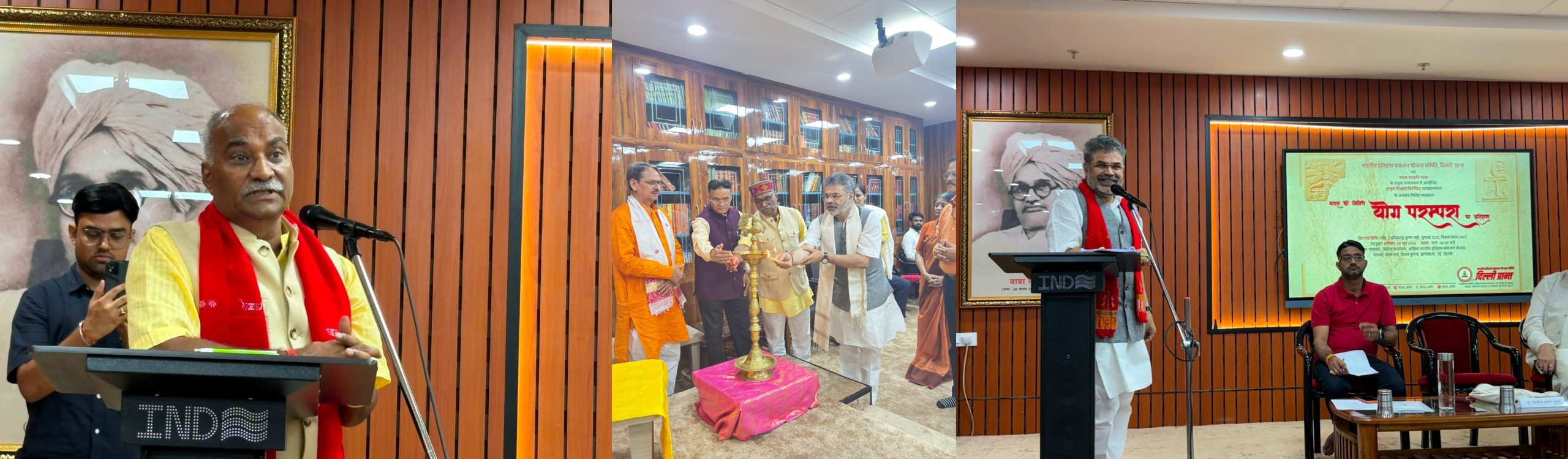
- Special lecture on the history of India’s diverse yoga traditions held in New Delhi
- Former Wardha University Vice-Chancellor Prof. Rajneesh Kumar Shukla delivered keynote address
- Speakers emphasised yoga as the practical expression of Indian philosophy
- More than 150 scholars, teachers and students attended the event
GG News Bureau
New Delhi, 7th June: A special lecture on the theme “History of India’s Diverse Yoga Traditions” was organised at Keshav Kunj, Jhandewalan, under the sixth edition of the Namoolam Likhyate Kinchit lecture series jointly hosted by the Delhi unit of the Akhil Bharatiya Itihas Sankalan Yojana (ABISY) and Madhav Sanskriti Nyas.
The keynote address was delivered by Prof. (Dr.) Rajneesh Kumar Shukla, former Vice-Chancellor of Mahatma Gandhi International Hindi University, Wardha, and National Vice-President of ABISY.
Speaking on the subject, Prof. Shukla traced the evolution of yoga from the Sindhu-Saraswati Civilization around 2700 BCE through the Vedas, Upanishads, Mahabharata, Bhagavad Gita, Patanjali Yoga Sutras, Hatha Yoga and Bhakti Yoga traditions to its contemporary global recognition through International Yoga Day.
He said yoga has emerged as a global symbol of Indian culture and stressed that the concepts of purity and inner discipline associated with yoga are collective rather than merely individual in nature.
Delivering the guiding address, Dr. Balmukund Pandey, National Organising Secretary of ABISY, said yoga represents the practical manifestation of philosophy.
“Philosophy provides the vision, while yoga is the discipline through which that vision is experienced in life. Yoga is the practical dimension of Indian philosophical thought,” he said.
He explained that while philosophy teaches that the soul is pure and capable of connecting with the Supreme, yoga offers the means to realise that truth through meditation, pranayama, asanas and self-discipline.
The programme was chaired by Padma Shri Prof. Buddha Rashmi Mani, noted archaeologist, historian, art critic and National Executive Member of ABISY.
In his presidential remarks, Prof. Mani said the ultimate purpose of yoga is to unite the individual soul with the Supreme Being. He noted that yoga helps establish harmony between body and mind through practices such as asanas and pranayama.
“Yoga is not merely a form of exercise or physical postures. It is a profound process of connection and unity that links individuals with themselves, society and the ultimate truth,” he said.
The programme began with an invocation by Dr. Piyush Mishra. The session was conducted by Dr. Saurabh Kumar Mishra, Deputy Director of the Indian Council of Historical Research (ICHR) and National Publicity Head of ABISY.
The vote of thanks was delivered by Dr. Sanjeev Kumar Mishra, Executive Committee Member of the Delhi unit of ABISY.
The event was organised under the coordination and leadership of Delhi State General Secretary Dr. Nirmal Pandey.
Several eminent scholars, historians, researchers and academicians attended the programme, including Prof. Sushmita Pandey, Surendra Hans, Vidhu Pandey, Dr. Narendra Shukla, Prof. Ramesh Kumar Mishra, Prof. Dharmachand Chaubey, Prof. Praveen Garg, Prof. Akhilesh Kumar Dubey and Prof. Yuthika Mishra.
More than 150 teachers, researchers, students and life members from various universities participated in the lecture, reflecting growing academic interest in India’s civilisational and cultural traditions.
