

Alok Lahad
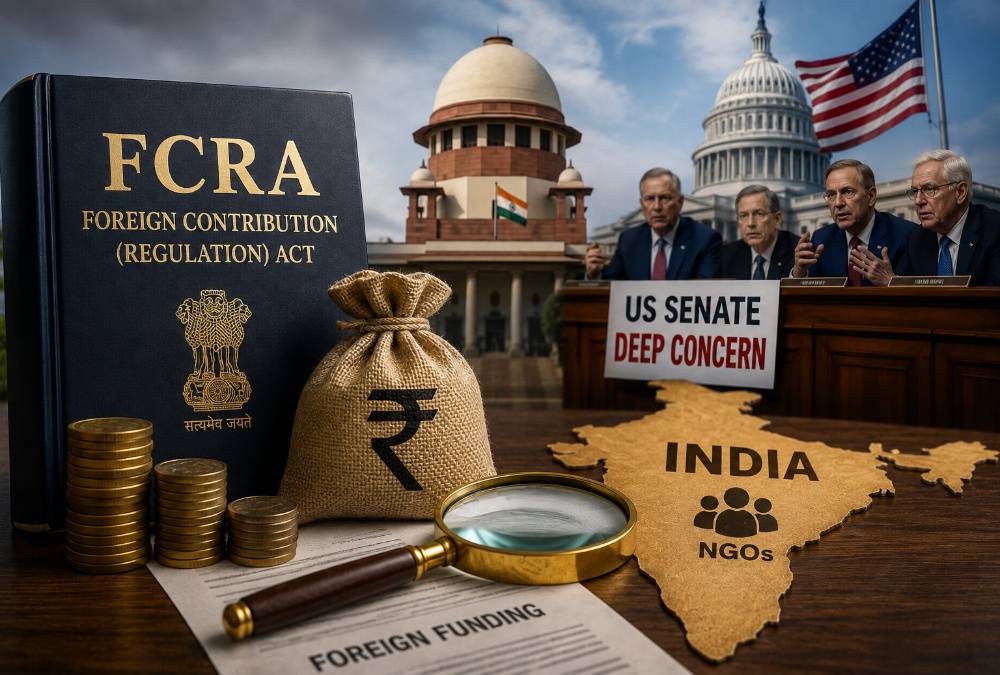
New Delhi: A routine domestic law meant to regulate foreign money flowing into Indian non-governmental organisations has suddenly become a bipartisan talking point on Capitol Hill. Both Republican and Democratic senators have expressed “deep concern” over proposed amendments to India’s Foreign Contribution (Regulation) Act. The noise is loud, but the facts are clearer when viewed from New Delhi.
What FCRA actually is
The Foreign Contribution (Regulation) Act was first enacted in 1976 during the Emergency under Indira Gandhi’s government to prevent foreign money from influencing Indian politics and sovereignty. It was comprehensively rewritten in 2010 by the UPA government and further tightened in 2020 and 2026 under the Modi government. The core principle has remained consistent across regimes: foreign donations to Indian associations must be transparent, purpose-specific, and not detrimental to national interest.
Similar concerns exist elsewhere. The United States has the Foreign Agents Registration Act (FARA) of 1938, which requires disclosure when someone acts under the direction of a foreign principal in political or influence activities. Australia, the United Kingdom, Canada and several European countries have introduced foreign influence transparency schemes in recent years. China maintains strict controls on foreign NGOs. Japan and France also regulate cross-border funding and political influence in different forms. No major democracy allows completely unchecked foreign money into its civil society space. India’s FCRA is stricter in requiring prior registration and in controlling residual assets, but the underlying anxiety about foreign influence is shared.
The numbers and the layering problem
India has several lakh registered non-profits and associations. Even taking conservative active figures, the absolute number is large. Only a small fraction — roughly 14,500 at last count — hold valid FCRA licences and can legally receive foreign contributions. The rest operate on domestic funds. The concern is not the existence of NGOs; it is the minority that receive large foreign inflows and the networks that move money between them.
Investigations have repeatedly shown how funds are layered through multiple organisations, making the final use difficult to track in real time. Some entities have been found operating from addresses that exist only on paper. In one widely reported instance involving organisations linked to political activism, registered addresses raised serious questions about genuine operations. When money can be moved across trusts and then disappear into agitation or unrelated assets, the original donor’s intent is lost and accountability collapses. The 2020 amendments banned inter-NGO transfers of foreign contribution precisely to break this layering. The 2026 changes go further on the asset side.
When charity becomes empire: Gospel for Asia and Greenpeace
Two cases illustrate the problem starkly.
Gospel for Asia and its Indian affiliates, including Believers Eastern Church and the later-renamed Ayana Charitable Trust, once ranked among the largest recipients of foreign funds in India — hundreds of crores in single years. In 2017 their FCRA registrations were cancelled. Parallel probes and Income Tax actions alleged diversion of charity money into real estate, including large plantation holdings. In the United States the same organisation faced donor lawsuits and lost its Evangelical Council for Financial Accountability membership over failures to honour donor intent. Ordinary American churchgoers who believed they were supporting missionaries and the poor later discovered that significant portions had gone into land banks and institutional expansion. After cancellation, the properties largely remained under the control of the trusts because the old Section 15 lacked a working mechanism.
Greenpeace India faced suspension and cancellation of its FCRA registration after Intelligence assessments and official orders linked its campaigns to sustained opposition against coal mining, thermal power and nuclear projects. Technical violations of reporting and spending rules were also cited. The organisation’s advocacy delayed projects that successive Indian governments considered critical for energy security and industrial growth. Similar patterns appeared in probes into other networks accused of funding or coordinating protests and litigation against mining, ports and industrial corridors.
These are not isolated complaints. They form the practical backdrop for the latest amendments.
Development delayed in the name of activism
India’s growth story requires power plants, mines, roads, ports and industrial corridors. Foreign-funded campaigns that prolong litigation and street mobilisation against these projects impose real economic costs. When the money originates overseas and is channelled through layered NGOs, the democratic choice of an elected government is indirectly challenged by external funding. FCRA has long contained grounds for action when foreign contribution is likely to affect economic or public interest. The amendments simply make the residual assets of cancelled organisations subject to clearer public-purpose control instead of leaving them in private hands.
Not a war on churches
The government has repeatedly clarified that the law is not aimed at genuine Christian institutions doing education, healthcare or social work. Prime Minister Narendra Modi has given personal assurances to senior Church leaders, including archbishops, that places of worship will retain their religious character and that the amendments target misuse, not faith. Legitimate religious activity remains permissible under the rules; what is restricted is the use of foreign money for proselytisation through inducement and the conversion of charity into private asset empires. American donors who give out of genuine religious conviction deserve protection from both.
Protecting American donors, not their political patrons
The proposed changes to the asset-vesting framework (the new Chapter replacing the incomplete old Section 15) ensure that when an organisation’s FCRA registration ends, foreign contributions and the assets built from it do not simply remain under the original management indefinitely. Provisional vesting followed by permanent vesting if registration is not restored creates a path for the money and assets to serve public purposes rather than private ones. This is the opposite of confiscating honest charity. It is an attempt to honour the original donors’ intent when the intermediary fails or is cancelled.
US senators raising alarm are responding more to domestic political constituencies and organised advocacy networks than to a careful reading of the Indian statute. Protecting the vote bank of certain religious and human-rights lobbies is easier than acknowledging that American donors themselves have been short-changed by misuse in the past. A transparent system that keeps foreign charity tied to its stated purpose serves those donors better than an open spigot with weak residual controls.
Good for India’s security and for honest American charity
A sovereign nation has the right — and the duty — to decide the terms on which foreign money enters its civil society space. FCRA, strengthened by successive governments of different political colours, is one such instrument. It protects internal security by limiting opaque foreign funding of political or destabilising activity. It protects development by reducing the ability of external money to indefinitely stall strategic projects. And it protects the good-hearted American or European donor whose only intention was to help the poor, educate a child or support a hospital — not to underwrite land banks or endless litigation.
The amendments close a long-standing loophole on what happens to assets after cancellation. That is not persecution. It is basic financial hygiene. Those who genuinely want transparent charity should welcome it. Those who prefer the old opacity have reason to be nervous. The rest of India need not share their jitters.
