
42 Retired Judges Warn Against Undermining Election Commission
Open letter says repeated attacks on constitutional institutions could erode public trust and fuel unrest

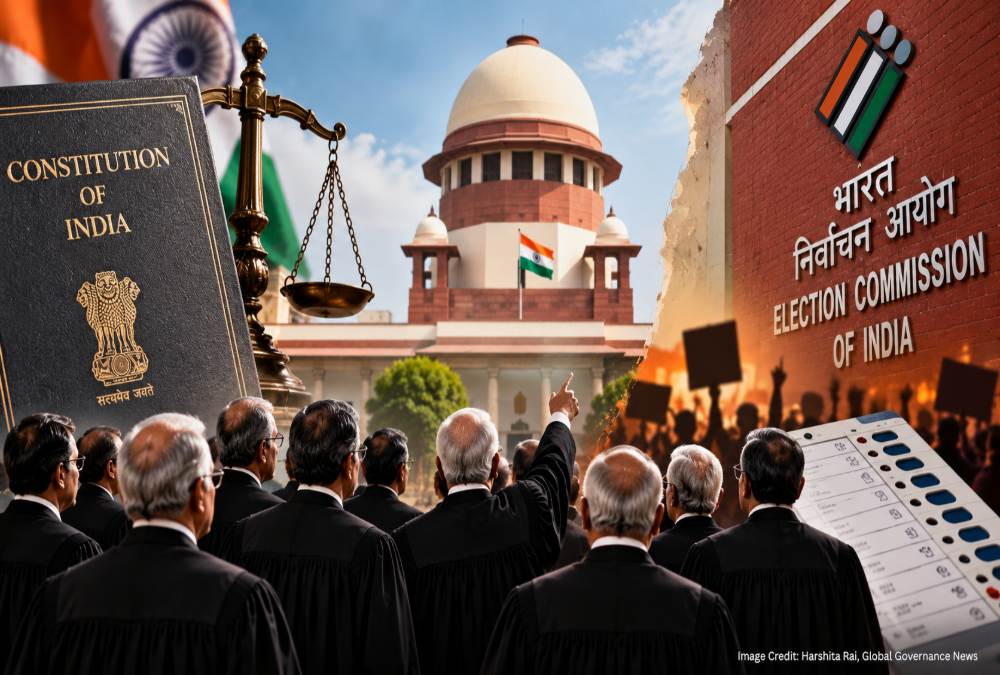
- 42 retired judges issue open letter on institutional credibility.
- Former judges defend SIR as a lawful electoral exercise.
- Letter warns against unsupported “vote theft” allegations.
- Judges say weakening ballot trust could fuel unrest.
GG News Bureau
New Delhi, 8th Oct: Forty-two retired judges, including former Supreme Court judges Justice Hemant Gupta and Justice Pankaj Mittal, have issued a strongly worded open letter warning against attempts to undermine the Election Commission of India and other constitutional institutions.
The letter comes amid escalating Opposition protests against Chief Election Commissioner Gyanesh Kumar and the Special Intensive Revision (SIR) of electoral rolls. The former judges expressed concern over what they described as a sustained campaign questioning the credibility of the Election Commission, judiciary and other statutory institutions.
The signatories questioned allegations of “vote theft” when, according to them, such claims were being made publicly without supporting evidence. They warned that repeatedly branding constitutional authorities as “thieves” or “compromised” could weaken public confidence in institutions.
“We write because, in moments like these, silence is no longer a neutral choice. Our concern is grave. India’s constitutional bodies are under sustained attack,” the letter said.
The judges argued that criticism of constitutional institutions is part of democratic discourse, but said there was a distinction between criticism and what they described as institutional denigration.
“Criticism of institutions is a democratic right. Denigration is not,” the letter stated.
The former judges also defended the Special Intensive Revision of electoral rolls, describing it as a legally established exercise intended to maintain clean and accurate voter lists.
They urged those with objections to use established constitutional and judicial mechanisms rather than undermine confidence in the electoral process.
A central warning in the letter was that declining faith in elections could have consequences beyond political debate.
“Trust is the currency of democracy,” the signatories said, adding that when the “ballot loses meaning, the street gains it”.
They further warned that public unrest can begin with narratives that weaken confidence in institutions and that such a vacuum could subsequently be exploited by fringe or anarchic elements.
The letter also questioned allegations surrounding electronic voting machines, pointing to what the signatories described as selective criticism of the electoral system after defeats while victories secured through the same system were not similarly challenged.
It also criticised activist groups that, according to the former judges, repeatedly approach courts with allegations but fail to place sufficient evidence on record. The judges argued that judicial proceedings should not become an extension of political campaigns and said court judgments should be respected even when they do not favour a particular side.
The signatories include former Supreme Court judges, former Chief Justices of High Courts and other retired judicial figures. Among the former High Court Chief Justices named are B.C. Patel, Subhro Kamal Mukherjee and Permod Kohli.
The intervention comes amid a wider debate over the voter-roll revision and the Election Commission’s functioning. Earlier this week, former Supreme Court judge Justice Rohinton Fali Nariman had expressed concern over the deletion of large numbers of voters and said the right to vote was “at great peril”.
Supreme Court Justice Ujjal Bhuyan had also questioned any process that could remove the voting rights of a large number of citizens, saying such an action would amount to a negation of the constitutional order.
The contrasting interventions have added another dimension to the ongoing debate over electoral rolls, institutional accountability and the limits of political criticism.
For the 42 retired judges, however, the larger concern is preserving public faith in the institutions through which electoral disputes are meant to be addressed.
