

Poonam Sharma
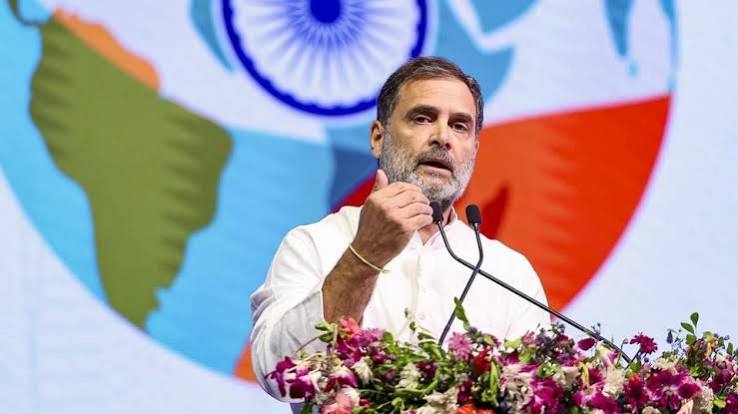
The case of Rahul Gandhi
In the Indian political landscape, the tone and language used by leaders, especially opposition leaders, are under a microscope. Recently, a prominent leader of the Indian National Congress, Rahul Gandhi, has spoken words that have ignited the debate over the bounds of political speech and the responsibilities that go with being in opposition in a democracy.
Political Critique to Personal Attack
The democratic opposition traditionally plays the essential part of questioning, challenging and holding the government to account. But recent trends indicate that the lines are being blurred, with policy criticism turning into personal attacks, and sometimes even a disregard for decorum. Rahul Gandhi’s remarks are increasingly being read as going beyond the bounds of vigorous political opposition to language that is widely seen as disrespectful not just to political opponents but to the offices they occupy. Rahul Gandhi has repeatedly used words against Prime Minister Narendra Modi and Home Minister Amit Shah that many consider personally offensive. Additionally, his comments concerning global leaders and India’s foreign policy have been criticized for not being diplomatic enough. The big question is: has political opposition in India come to mean creating controversy over every issue, even at the cost of statesmanship and maturity?
Role and Responsibility of Opposition Party
In India’s parliamentary democracy, the leader of the opposition has a powerful and dignified position. In the past, opposition leaders had been sent as representatives of the nation on sensitive foreign matters, even when the Congress party was in power. Today, we look to the leaders of all political persuasions to behave with the decorum and respect due to their offices. Rahul Gandhi’s approach often betrays a frustration, personal and within his party, that his leadership ambitions have gone unfulfilled. There is a growing sense that his political style is more about keeping himself in the spotlight with provocative statements than about providing constructive criticism or viable alternatives. Some people wonder whether Rahul Gandhi’s upbringing and political apprenticeship have prepared him for a national leadership role, or whether his continued reliance on personal attacks is a symptom of deeper problems within the Congress party itself.
Family Background and Public Image
Rahul Gandhi is a member of the Nehru-Gandhi family that has played a prominent role in Indian politics for decades. But in recent years his critics say he has not lived up to the legacy of statesmanship and has focused on negative campaigning. His statements are increasingly being likened on social media to those made in the privacy of one’s drawing room not the parliament floor. Within his own party there is open and silent debate over whether he is “fit for the role” of Prime Minister. Some say his place is more inherited than earned. References to ancient Indian wisdom are even more incendiary. One example is Chanakya’s dictum that “a person born of a foreign woman can never be president,” as well as insinuations that Rahul Gandhi’s background makes him less fit to lead.
Leadership Differences :Modi vs Gandhi
The rise of the self-made leader narrative and development focus of Narendra Modi has created a stark contrast. Supporters of Modi point to the massive expansion of infrastructure, digital banking and social welfare schemes under his leadership, far outpacing the Congress era. Modi’s mass connect, disciplined party management and single-minded vision is starkly different from what critics say is Rahul Gandhi’s erratic and knee-jerk politics.
The Future of Dissent in Indian Democracy
The current trend of negativity and personal attacks in opposition politics raises an important question: Has the Congress’s political strategy become one of opposing every move of the government, irrespective of merits? his frequent trips abroad, alleged outside direction and focus on attacking the Modi government show a lack of independent vision and leadership. As India continues to grow, it faces new global challenges and there is an urgent need for a mature, responsible and forward-looking opposition. The strength of the government is important but the quality of opposition discourse is also crucial to the democratic health of the country. The trajectory of Rahul Gandhi and the Congress party will continue to define the future of political civility and leadership in India.
