
India Highlights Healthcare Workforce Expansion at WHO RC79
Union Health and Family Welfare Minister J.P. Nadda stresses equitable access to specialised care for rural, tribal and underserved populations at WHO RC79

- Medical colleges more than doubled from 387 in 2014 to 858.
- MBBS seats rose to 1,42,464, while PG seats reached 86,287.
- India is adding 157 nursing colleges and 1 lakh allied healthcare professionals.
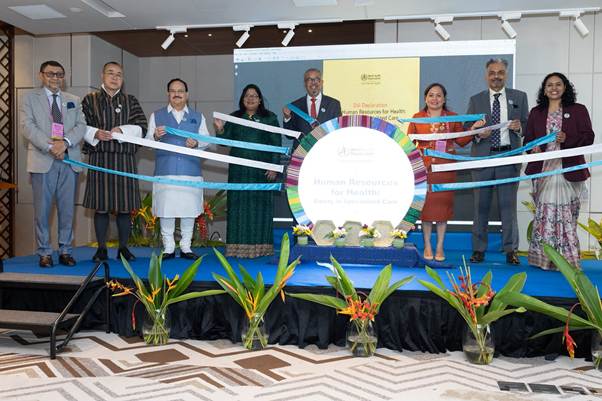
- WHO South-East Asia adopted the Dili Declaration on equity in specialised care.
GG News Bureau
DILI, 9th Sept: Union Health and Family Welfare Minister J.P. Nadda highlighted India’s major expansion of its medical, nursing and allied healthcare workforce while stressing the need for equitable access to specialised care for rural, tribal and underserved populations.
Addressing the Ministerial Roundtable on “Human Resources for Health: Equity in Specialized Care” at the 79th Session of the WHO Regional Committee for South-East Asia (RC79) in Timor-Leste, Nadda said equitable access to specialised healthcare is integral to achieving Universal Health Coverage.
He emphasised that strengthening specialised care requires a comprehensive approach covering education and training, deployment, retention and continuing professional development of healthcare professionals.
Nadda said the number of medical colleges in India has increased from 387 in 2014 to 858, a rise of 121.71 per cent. MBBS seats have increased from 51,348 to 1,42,464, while postgraduate seats have risen from 31,185 to 86,287.
The government has also targeted the creation of 10,000 additional postgraduate seats by 2028–29, with priority to underserved areas and shortage specialities such as Emergency Medicine, Geriatrics, Psychiatry and Family Medicine.
Nadda highlighted the establishment of 157 new nursing colleges co-located with existing medical colleges. These institutions are expected to add around 15,700 nursing graduates annually. Nurse Practitioner programmes have also been introduced in 10 critical specialities.
The government has announced the creation of 1 lakh allied and healthcare professionals over five years. The National Commission for Allied and Healthcare Professions brings 57 allied and healthcare professions under a structured regulatory framework.
The Minister also highlighted Ayushman Arogya Mandirs, Ayushman Arogya Shivirs, Community Health Centres and First Referral Units in expanding primary, specialist and referral services. Digital platforms such as eSanjeevani and ABHA-enabled health records are being used to overcome geographical barriers and facilitate teleconsultations and referrals.
At the WHO regional session, Member States adopted the Dili Declaration on Human Resources for Health: Equity in Specialized Care. The declaration calls for addressing health workforce shortages and maldistribution, particularly in rural and underserved areas, while strengthening specialist outreach, teleconsultation, referral systems and digital health.
India was also honoured with two WHO South-East Asia Regional awards for sustaining the regional elimination of maternal and neonatal tetanus and for leadership in addressing noncommunicable diseases through primary healthcare, including protocol-based management of hypertension and diabetes.
Nadda dedicated the recognitions to frontline health workers and reaffirmed India’s commitment to Universal Health Coverage through investments in health infrastructure, human resources, primary healthcare, digital health and health system resilience.
