
India’s Start-up Ecosystem Creates 25 Lakh Jobs
Union Minister Dr Jitendra Singh says Startup India has transformed innovation into a nationwide movement

- India’s start-up ecosystem expands from 350 to 2.3 lakh ventures in a decade
- Nearly 25 lakh jobs created through startup-driven growth
- More than 50% of startups now emerge from Tier-2 and Tier-3 cities
- Over 125 startups participate in RISE Conclave 2026 in Bengaluru
GG News Bureau
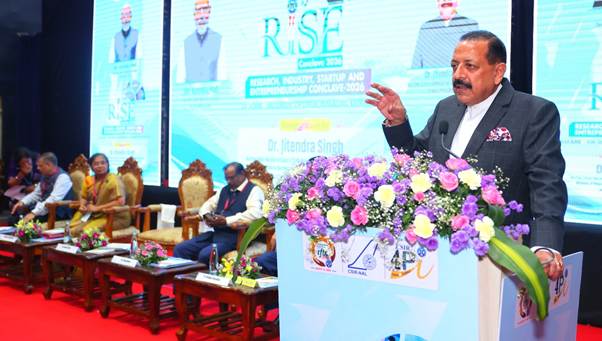
Bengaluru, 14th June: Union Minister of State (Independent Charge) for Science and Technology, Dr. Jitendra Singh, on Saturday said India’s startup ecosystem has generated nearly 24-25 lakh jobs over the last decade, while the number of startups has grown from around 350-400 to nearly 2.3 lakh, making India the world’s third-largest startup ecosystem.
Addressing the RISE Conclave 2026 in Bengaluru on the theme “Innovation & Entrepreneurship Driven Growth for Viksit Bharat 2047”, the minister said the country’s transformation into a vibrant innovation economy has been driven by a supportive policy framework and growing entrepreneurial confidence.
Highlighting the role of Prime Minister Narendra Modi’s vision, Dr. Singh said the launch of the Startup India initiative in 2015 laid the foundation for a nationwide innovation movement.
He noted that subsequent reforms opened strategic sectors to private participation and encouraged young Indians to pursue entrepreneurship and innovation-led careers.
“The Startup India call transformed innovation into a national movement and created an ecosystem that is enabling India to harness its demographic dividend,” the minister said.
Dr. Singh stated that the RISE Conclave was designed to bring together the four pillars of Research, Industry, Startups and Entrepreneurship under a common platform, fostering collaboration among scientists, investors, industry leaders, academia and policymakers.
The minister highlighted the growing momentum in India’s aerospace innovation ecosystem, noting that mach33.aero, the country’s first public-private aerospace incubation centre established by CSIR-NAL and its partners, has completed five years of operations and incubated 34 startups.
He said more than 125 startups are participating in the Bengaluru edition of RISE Conclave 2026, many of them from the aerospace and deep-tech sectors, reflecting growing confidence among young innovators in advanced technology domains.
Dr. Singh emphasized that the geography of entrepreneurship in India is changing rapidly, with over half of all startups now emerging from Tier-2 and Tier-3 cities.
According to him, innovation and entrepreneurship are no longer confined to metropolitan centres and are increasingly accessible to individuals with talent, commitment and technological aptitude irrespective of their location.
The minister also highlighted the opening of previously restricted sectors such as space, biotechnology, deep-ocean exploration and nuclear energy to private participation, saying these reforms have created new opportunities for startups and innovators.
Referring to India’s growing global innovation profile, Dr. Singh said the country’s ranking in the Global Innovation Index has improved substantially over the past decade, while patent filings and the quality of scientific research output have also increased.
He cited the progress achieved under the National Quantum Mission and the IndiaAI Mission, describing them as important drivers of future technological growth.
The minister said the success of RISE Conclave should ultimately be measured by concrete outcomes such as technology transfers, startup incubation, investments secured, industry partnerships established, products commercialised and jobs created.
The conclave featured discussions on aerospace technologies, artificial intelligence, agri-food innovation and emerging technologies, along with exhibitions and interactions involving startups, MSMEs, investors, scientists and academic institutions.
Concluding his address, Dr. Singh said India’s journey towards becoming a developed nation by 2047 would be powered by innovation, science, technology and the aspirations of its youth.
