
Trump Threatens New Iran Strike, Calls Conflict ‘Small Potatoes’
US president warns Pickaxe Mountain could be hit soon while claiming there is currently no fighting

By Anjali Sharma
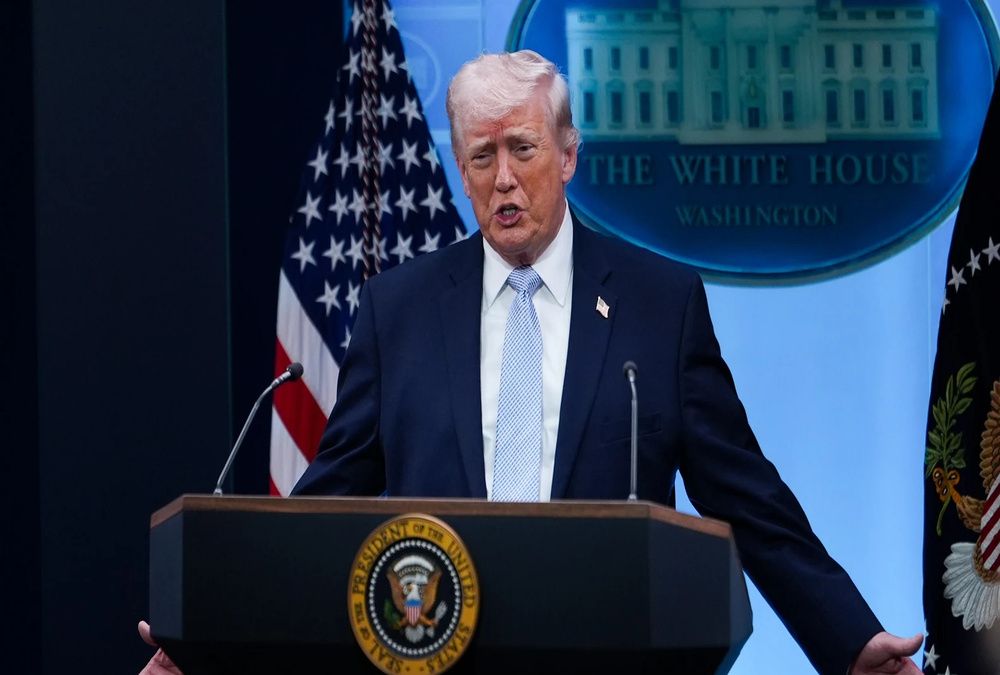
WASHINGTON – US President Donald Trump on Saturday has played down the months-long military confrontation with Iran as “small potatoes” even as he threatened another strike on a heavily fortified site near the Natanz nuclear complex ‘Pickaxe Mountain’.
Trump acknowledged that 18 US service members had been killed but compared the toll with longer US wars and insisted there was currently “no fighting”.
He said the US could hit Iran’s Pickaxe Mountain “very soon” if it detected activity there.
Trump warning came days after US forces carried out another wave of strikes against Iranian military targets.
“Well, I’ll tell you what, a lot of people don’t call it a war. I call it a military conflict because it’s small potatoes for us. It’s not a big thing,” Trump told reporters
Vice President JD Vance declined to characterize the confrontation as a war.
Trump acknowledged that 18 US service members had been killed during the conflict but contrasted the toll with that of longer American wars, including Vietnam and Afghanistan.
“I would say that it’s intermittent. You know, we do intermittent strikes,” Trump said. “We’re not fighting right now. There’s no fighting.”
Trump defended the military campaign and returned to his administration’s stated objective of preventing Tehran from acquiring a nuclear weapon when asked about describing the confrontation as “small potatoes” despite the deaths of American troops.
“Iran will not have a nuclear weapon. We’ve stopped them from having,” he said.
Trump raised the prospect of another US attack, this time against Pickaxe Mountain, a fortified complex near Iran’s damaged Natanz uranium-enrichment facility.
“We may hit Pickaxe very soon because if there was anything going on with Pickaxe,” he said.
The site contains two deeply buried tunnel complexes.
Trump claimed Washington was closely tracking movements at the site and elsewhere in Iran.
“We know everybody that’s moving at Pickaxe; we know everybody that’s moving everywhere all over Iran. And if anything goes bad, we hit them; we hit them hard,” Trump said.
The latest warning follows a fresh round of American military action.
US Central Command said its forces struck Islamic Revolutionary Guard Corps targets on September 1, including air-defence sites, radar systems, maritime assets, mine-laying capabilities and communications facilities.
CENTCOM said those strikes followed attempted IRGC attacks against commercial shipping in the Strait of Hormuz and American service members.
Trump also claimed American forces had repeatedly destroyed sophisticated Iranian radar systems.
“They had very sophisticated radar – they brought in radar because we knocked it out once, and now we knocked it out twice. Now we don’t notice any activity,” he said.
“I think they’re tired of putting it in and getting blown up.”
Trump also claimed the United States was firmly in control of the Strait of Hormuz and that American minesweepers had removed Iranian mines from the strategic waterway.
“We control the Hormuz Strait, and we control it very strongly,” he said.
CENTCOM has separately said commercial vessels continue to transit the Strait with US military support.
Trump described the scale of US power over Iran.
“We took over Venezuela and we have essentially taken over Iran,” he said.
He claimed Iran would need 25 years to rebuild if the United States ended its operation immediately, but gave no timetable for bringing the confrontation to an end.
“But I want to leave so that the next president doesn’t have to worry about it,” he said.
Trump also addressed China’s relationship with Iran, saying he had personally asked Chinese President Xi Jinping not to become involved.
“I said, please don’t get involved to President Xi,” Trump said. “And they’re not really involved, very little involvement by China.”
He said China receives significant oil supplies through the Strait of Hormuz, but argued that new pipelines and an overland route through Syria were reducing dependence on the waterway.
“The Hormuz Strait is not what it used to be,” Trump said.
He concluded “Pipelines are being built all over the Middle East now, so they don’t have to go through the Hormuz Strait.”
