
UDAN Expansion, Pilot Training Reforms Reviewed in Mysuru
Civil Aviation Consultative Committee discusses next phase of UDAN, aviation workforce development and IGRUA transformation

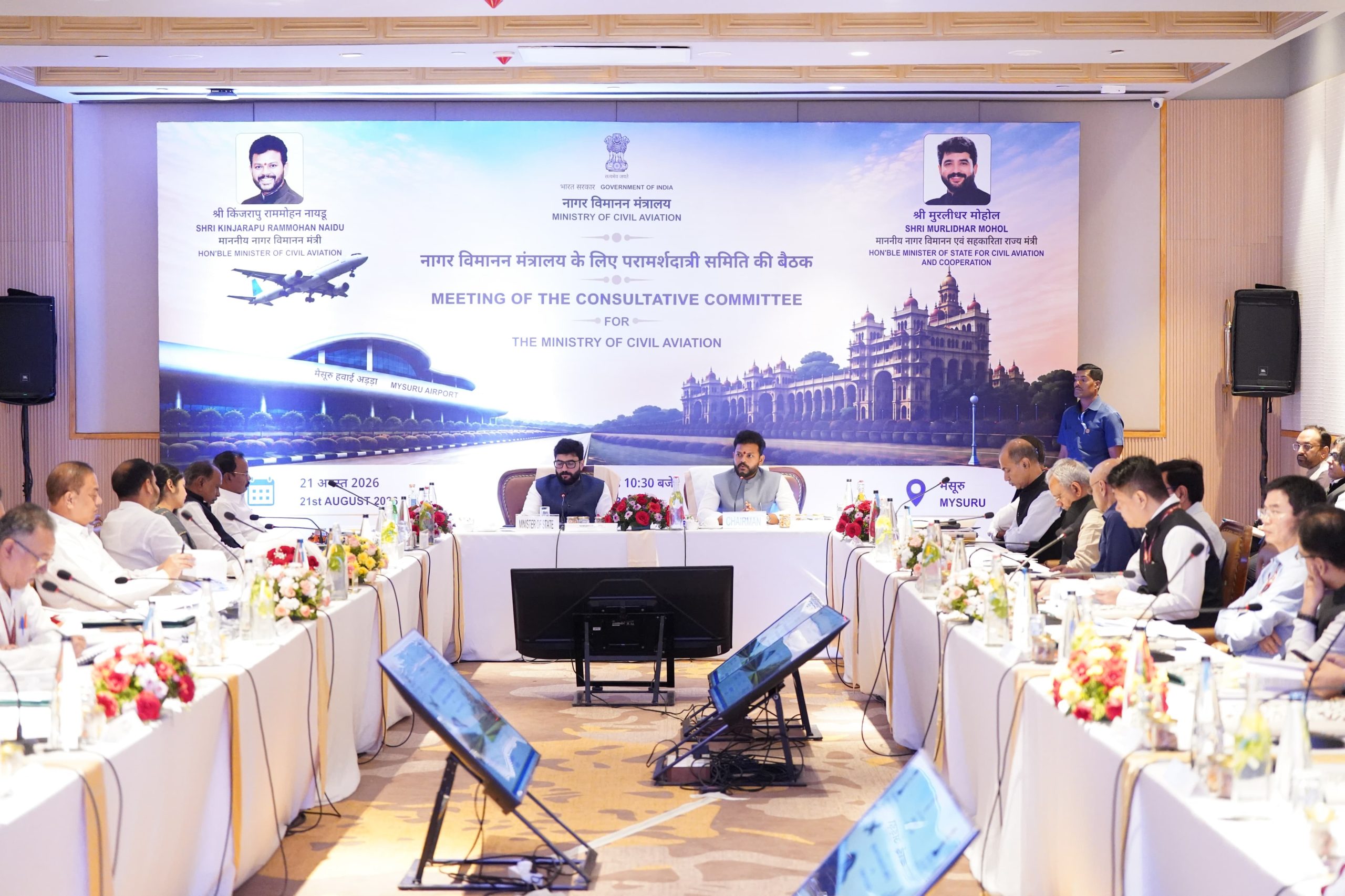
- Ram Mohan Naidu chaired the Civil Aviation Consultative Committee meeting in Mysuru.
- Members reviewed the next phase of UDAN and reforms in pilot training.
- Government highlighted ₹28,840 crore planned for the next phase of UDAN.
- Focus remained on strengthening India’s aviation workforce and regional connectivity.
GG News Bureau
Mysuru, 21st Aug: Union Civil Aviation Minister Ram Mohan Naidu chaired the Parliamentary Consultative Committee of the Ministry of Civil Aviation in Mysuru on Friday, where Members of Parliament reviewed the next phase of the UDAN regional connectivity scheme, reforms in the Flying Training Organisation (FTO) ecosystem and the transformation of the Indira Gandhi Rashtriya Uran Akademi (IGRUA).
The meeting, attended by Union Minister of State for Civil Aviation and Cooperation Murlidhar Mohol, along with Members of Parliament and senior ministry officials, marked the first time since 2017 that the Parliamentary Consultative Committee met outside New Delhi.
Addressing the committee, Ram Mohan Naidu said India’s aviation sector is now extending beyond airport development to become a key driver of regional development and inclusive economic growth. He said the government’s vision under Prime Minister Narendra Modi’s UDAN initiative is benefiting farmers, exporters, businesses and local communities while opening new opportunities in emerging sectors such as drones and electric vertical take-off and landing (eVTOL) aircraft.
Highlighting the expansion of the regional connectivity programme, the minister said nearly ₹10,000 crore had been invested over the past decade in airport development and viability gap funding for airlines. He added that the government has now approved an unprecedented ₹28,840 crore for the next phase of UDAN to further strengthen regional air connectivity across the country.
The committee also reviewed reforms aimed at strengthening India’s pilot training ecosystem. Officials informed members that the number of Flying Training Organisations has increased from 32 in 2020 to 41 in 2026, while flying bases have expanded from 32 to 63 during the same period. The ministry said the FTO ranking framework has introduced greater transparency and accountability, enabling aspiring pilots to make informed choices while maintaining high safety standards.
Speaking on India’s aviation ambitions, Naidu noted that Indian airlines have placed aircraft orders on an unprecedented scale globally, creating a significant demand for skilled aviation professionals. He stressed that India aims to train its own pilots and aviation workforce domestically instead of relying on foreign manpower.
The committee also reviewed the performance of Indira Gandhi Rashtriya Uran Akademi (IGRUA). Officials said the academy has increased aircraft utilisation to an average of 1,765 flying hours per aircraft annually, surpassing the global benchmark of around 1,500 hours, while achieving a budget surplus for the first time in over two decades after years of recurring deficits.
Senior officials from the Ministry of Civil Aviation, the Directorate General of Civil Aviation (DGCA), the Airports Authority of India (AAI) and the Bureau of Civil Aviation Security (BCAS) briefed Members of Parliament on ongoing reforms and future initiatives. The minister appreciated the suggestions received from committee members and assured that they would be considered as the ministry advances India’s civil aviation growth strategy.
