

By Anjali Sharma
UNITED NATIONS – New head of the UN Mine Action Service agency Kazumi Ogawa on Saturday said that the demining experts from around the world have been sharing their collective shock at the widespread and growing threat from unexploded ordnance.
Ogawa said “They’re telling me, ‘Never in my career have I ever seen so many conflicts,’” speaking at the close of a Mine Action National Directors and UN advisers meeting in Geneva.
Ms. Ogawa noted that despite the clear need to continue demining work in the world’s conflict zones and those now at peace, “for various reasons, the level of funding has gone down in terms of humanitarian assistance”.
She stressed that in Gaza, a staggering 90% of the people that are injured by explosive hazards from the Hamas-Israel war are civilians “and of those, the majority of them are children”.
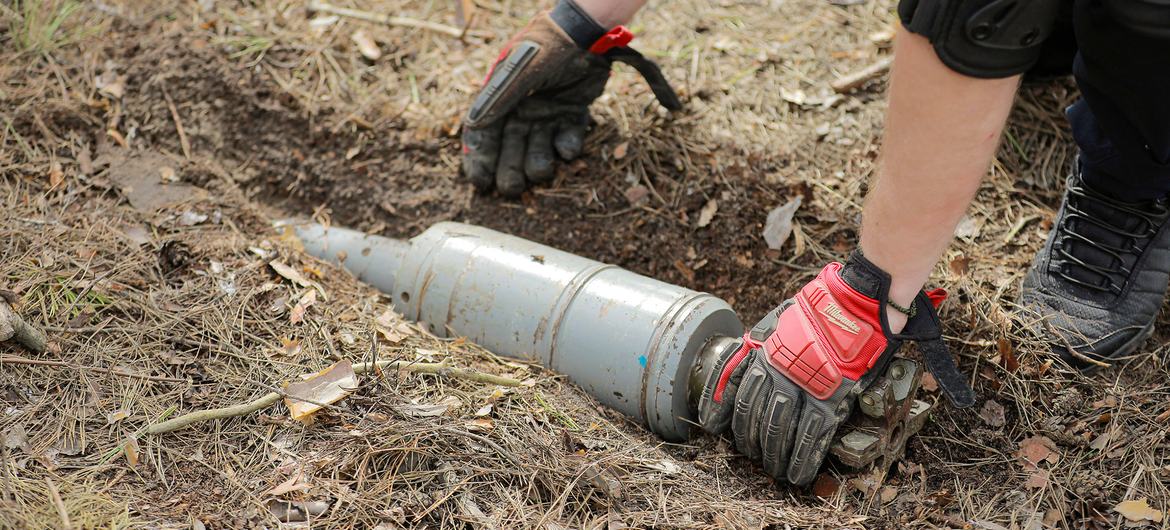
UNMAS has warned that between five and 10 per cent of all munitions fired in Gaza have not detonated. The result is that potentially lethal unexploded ordnance is now “ingrained” in the devastated enclave, the mine action service chief said.
“We can gather the explosive hazards and we cordon them off in Gaza so they’re blocked off, but we’re not able to destroy them…And so, they sit there in piles that children are expected to walk around.”
She added: “You have fathers that will go through the rubble to try to get home and find explosive devices and won’t know what to do with it; you’ll find children that are playing, right, and coming across these hazards.”
Ms. Ogawa reiterated that despite such a massive threat, there’s never enough support for demining and risk education, particularly today, amid a crisis in support for international agencies and bodies including the UN, and a spike in the number of conflicts.
“The problem is, as budgets national budgets – are diverted towards, defence and away from humanitarian assistance, what we’re seeing is the effect of that on the ground,” said Ms. Ogawa.
“So, in Afghanistan, for example, one child is killed every day.”
She added that the problem is no less shocking in Syria.
Ms. Ogawa said “Where normally you would have maybe 300 people killed, through explosive hazards in one year in a particular mine-ridden country, in Syria, you have 200 people killed a week.”
“It’s unimaginable. And these are the kinds of things that that donor funding would greatly help us with: explosive ordnance risk education, victim assistance, the actual clearance, advocacy to larger parts of the humanitarian community…to ensure that these people stay safe.”
She asserted that in addition to the human cost of landmines and other unexploded remnants of war, the economic impact is a significant brake on development too.
“If a child is maimed, you’re asking the family to take care of that child through adulthood, the community to make concessions for that child as he or she becomes a participant in the community. I mean, it’s just it’s not just one person dying, right?” Ms. Ogawa explained.
She highlighted the positive work supported by the UN around the world to counter landmines and other unexploded weapons, which is helping communities and nations to rebuild.
In Colombia, where there’s a legacy of antipersonnel mines and other explosive ordnance contamination from the decades-long civil war, an initiative from national transitional justice mechanism involves former fighters “to help with the recovery and restoration of those communities, including through demining and mine action, victim assistance, risk education”, Ms. Ogawa said.
“It’s a way of incorporating – instead of penalizing the ex-combatants by putting them in jail, it’s really incorporating them to be a part of the community.”
She added if you talk to the Special Jurisdiction for Peace in Colombia, it’s super exciting what they’re doing.”
The 1997 international treaty to eradicate landmines known officially as the Anti-Personnel Landmines Convention has proved effective at prohibiting antipersonnel landmines but in 2025 and early 2026, several European nations initiated or completed the process of withdrawing from it.
Ms. Ogawa stressed the value of the Treaty and its relevance to everyone, everywhere:
“Let’s remember that we’re here not just for adherence to international conventions for the sake of adherence for us to be able to say, ‘Oh, here’s one more country.’ It’s so that it then trickles down and creates the conditions for people to live in safety and security,” she concluded.
