
India’s Space Economy Set to Touch $45 Billion: Jitendra Singh
Union Minister says over 400 space startups are powering India's rise as a global space and innovation hub

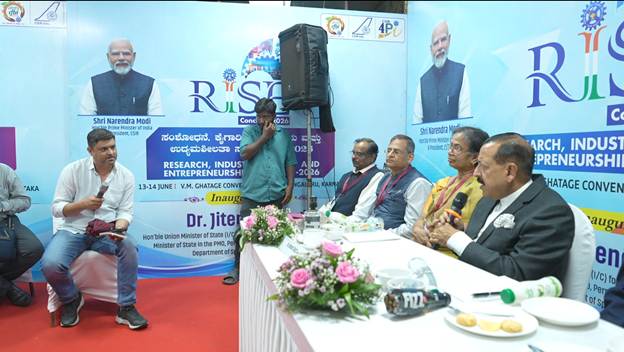
- India’s space economy projected to reach $45 billion in the next decade
- More than 400 space startups now active across the country
- Space technology increasingly driving governance and infrastructure development
- Chandrayaan-3 and Gaganyaan strengthening India’s global space leadership
GG News Bureau
New Delhi, 15th June: Union Minister of State (Independent Charge) for Science and Technology Dr. Jitendra Singh on Sunday said India’s space economy is poised to expand from the current $8-9 billion to nearly $40-45 billion over the next decade, driven by policy reforms, private sector participation and a rapidly growing innovation ecosystem.
Addressing a press conference during the RISE Conclave 2026, the minister said India’s space sector has undergone a remarkable transformation in recent years and is emerging as a major contributor to economic growth, technological self-reliance and global competitiveness.
Dr. Singh noted that one of the biggest achievements of recent years has been the growing connection between science and society, with citizens increasingly viewing themselves as stakeholders in India’s scientific progress.
“The common citizen today feels connected to India’s scientific achievements and sees a stake in them,” he said.
The minister credited Prime Minister Narendra Modi’s emphasis on science and innovation for bringing technology-driven initiatives into the national mainstream. He said programmes such as Digital India, Swachh Bharat, Digital Health, Deep Ocean Mission and Gaganyaan have helped place science and innovation at the centre of India’s development agenda.
Highlighting the impact of space sector reforms, Dr. Singh said India now has more than 400 space startups, compared to only a handful a few years ago. He described the growth as evidence of the enormous potential of the country’s space economy.
He said landmark missions such as Chandrayaan-3 and the upcoming Gaganyaan programme have established India among the world’s leading space-faring nations while demonstrating the country’s ability to execute complex missions efficiently and cost-effectively.
The minister also emphasized India’s unique use of space technology in governance and public service delivery.
He said initiatives such as PM Gati Shakti, AMRUT urban development programmes and drone-enabled monitoring systems are helping improve planning, implementation and monitoring of infrastructure projects while enhancing transparency and efficiency.
According to Dr. Singh, India has successfully integrated satellite-based applications into governance and development on a scale rarely seen elsewhere in the world.
Referring to recent developments in the space programme, he said the analysis of the PSLV mission anomaly has been completed and corrective measures have already been initiated. Future missions, he added, will benefit from these learnings.
The minister stressed that temporary setbacks should be viewed in the broader context of scientific advancement and technological evolution, noting that India’s overall space mission success rate compares favourably with major global space powers.
Dr. Singh further said that the country’s growing innovation ecosystem, supported by startups, industry and research institutions, will play a critical role in achieving the vision of Viksit Bharat 2047.
The RISE Conclave 2026 brought together researchers, industry leaders, investors, policymakers and more than 125 startups showcasing innovations in aerospace technologies, artificial intelligence, deep-tech and agri-food sectors.
