
Vikram-1 Launch Establishes India as Global Space Power: Jitendra Singh
Union Minister says Skyroot's success validates PM Modi's space reforms and strengthens India's commercial space ambitions

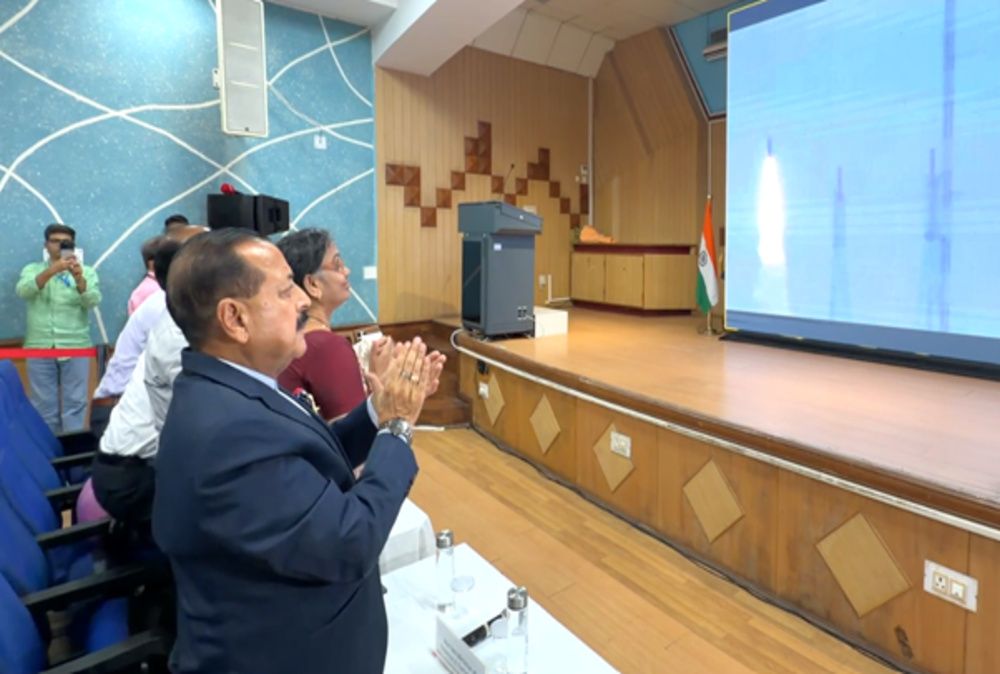
- Vikram-1 becomes India’s first privately developed orbital launch vehicle to reach orbit.
- Dr. Jitendra Singh credits PM Modi’s space reforms for the milestone.
- Mission marks a major boost for India’s private space ecosystem.
- Minister says Vikram-1 strengthens India’s position in the global commercial space market.
GG News Bureau
New Delhi, 18th July: Union Minister Dr. Jitendra Singh on Saturday said the successful launch of Vikram-1, India’s first privately developed orbital launch vehicle, has established the country as a serious global space power and validated Prime Minister Narendra Modi’s landmark decision to open the space sector to private participation.
Witnessing the launch of Mission Aagaman at the Satish Dhawan Space Centre in Sriharikota, the Minister congratulated Skyroot Aerospace, ISRO, IN-SPACe, and the Department of Space for achieving a historic milestone in India’s space programme.
Describing the mission as a defining moment for the country’s expanding space ecosystem, Dr. Singh said the success reflects the strength of India’s public-private partnership model and demonstrates the growing capabilities of the nation’s start-up ecosystem.
He credited the space sector reforms introduced in 2020 by the Modi government for creating an environment where Indian private companies can develop world-class launch vehicles and compete globally.
Congratulating Skyroot Aerospace founders Pawan Kumar Chandana and Bharath Daka, the Minister said the reforms unlocked the potential of Indian innovators by providing access to national space infrastructure and enabling advanced technologies to be designed, developed and launched from India.
Dr. Singh also praised ISRO and IN-SPACe for building a seamless framework that has accelerated innovation and transformed India’s commercial space ecosystem.
Highlighting the technical achievement, he said Vikram-1 successfully placed experimental and customer payloads into Low Earth Orbit, validating critical propulsion, avionics, navigation, telemetry and flight-control systems. Unlike many maiden launches globally, the mission carried multiple technology demonstration payloads from Indian and international customers.
The Minister noted that India now has more than 400 space start-ups, its first space unicorn and a space economy valued at nearly USD 9 billion, with a vision to expand it to around USD 44 billion over the next decade.
Built entirely in India, the 22-metre-tall Vikram-1 can place payloads of up to 350 kilograms into Low Earth Orbit. The launch vehicle incorporates several indigenous technologies, including an all-carbon composite structure, a 100 per cent 3D-printed liquid engine for its Orbital Adjustment Module, advanced separation systems and a monolithic carbon-composite rocket stage.
Calling the mission a turning point for India’s space ambitions, Dr. Jitendra Singh said the success of Vikram-1 demonstrates how visionary policy, scientific excellence and entrepreneurial talent can together position India among the world’s leading space-faring nations.
“For India, the sky is no longer the limit,” the Minister said.
