
PM-AASHA Strengthens MSP Support for Farmers
Government expands procurement, digital reforms and budget support to ensure better prices and reduce distress sales

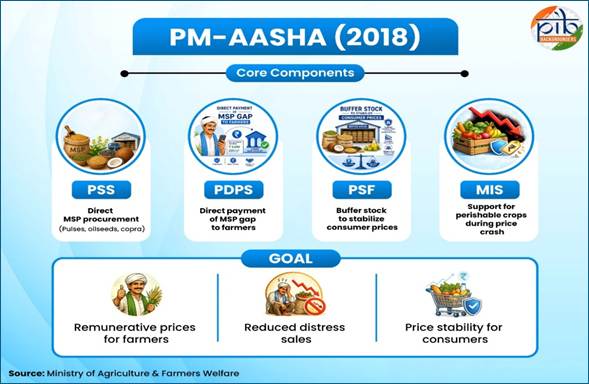
- PM-AASHA receives ₹7,200 crore allocation for 2026–27 to strengthen MSP operations.
- Scheme integrates PSS, PSF, PDPS and MIS for comprehensive price support.
- Digital reforms and expanded procurement improve transparency and farmer access.
- Bihar and Chhattisgarh report higher pulse procurement under the scheme.
GG News Bureau
New Delhi, 21st Aug: The Centre has strengthened its flagship Pradhan Mantri Annadata Aay Sanrakshan Abhiyan (PM-AASHA) with a ₹7,200 crore budget allocation for 2026–27, reinforcing its commitment to ensuring remunerative prices for farmers through enhanced Minimum Support Price (MSP) operations, expanded procurement and digital reforms.
Launched in 2018, PM-AASHA serves as the government’s umbrella framework for MSP-based price support, aiming to protect farmers from distress sales while maintaining price stability for consumers. Procurement of pulses, oilseeds and copra is carried out through agencies such as the National Agricultural Cooperative Marketing Federation (NAFED) and the National Cooperative Consumers’ Federation (NCCF) in coordination with state governments.
The scheme comprises four major components — the Price Support Scheme (PSS), Price Stabilization Fund (PSF), Price Deficiency Payment Scheme (PDPS) and Market Intervention Scheme (MIS). Together, these mechanisms support procurement at MSP, compensate farmers when market prices fall, stabilise prices of essential commodities and provide intervention for perishable crops such as tomatoes, onions and potatoes.
The government said procurement arrangements are prepared before every marketing season to ensure farmers receive MSP benefits without delays. From the 2024–25 procurement year, procurement of pulses, oilseeds and copra is permitted up to 25 per cent of a state’s production, while procurement of tur, urad and masur has been expanded to 100 per cent of state production to boost domestic pulse output and reduce imports.
Digital reforms have further strengthened the implementation of PM-AASHA. Aadhaar-enabled authentication, e-NAM, e-Samriddhi and e-Samyukti platforms have improved transparency, farmer verification and procurement efficiency. The government has also introduced biometric authentication, direct procurement from pre-registered farmers and transportation support for Tomato, Onion and Potato (TOP) crops.
According to official data, the scheme’s budget has increased steadily from an actual expenditure of ₹5,437.99 crore in 2024–25 to ₹6,941.36 crore in 2025–26, reaching ₹7,200 crore in 2026–27.
The Centre also highlighted remunerative MSP margins across major crops. During 2026–27, paddy (common) received an MSP of ₹2,441 per quintal against a production cost of ₹1,627, while wheat received ₹2,585 per quintal against a production cost of ₹1,239. Soybean and jute also recorded significant margins above production costs, strengthening farmers’ income security.
The government said initiatives such as the Agriculture Infrastructure Fund (AIF) and e-NAM have complemented PM-AASHA by improving farm-to-market connectivity. Loans worth ₹96,426 crore have been sanctioned under AIF for over 2.14 lakh projects, while e-NAM has integrated 1,656 mandis across 23 states and four Union Territories, facilitating agricultural trade worth ₹4.94 lakh crore.
Implementation has also expanded in states such as Bihar and Chhattisgarh. Bihar has initiated organised procurement of masoor for the first time through NCCF and NAFED, while Chhattisgarh has strengthened procurement of chana, masoor and mustard through an extensive network of Primary Agricultural Credit Societies (PACS) and Farmer Producer Organisations (FPOs).
The government said PM-AASHA continues to strengthen farmers’ incomes through assured procurement, better market access, digital transparency and expanded infrastructure, helping build a more resilient agricultural economy while reducing distress sales across the country.
