

Before the age of social media, reputations were built slowly, through carefully crafted arguments and well-written newspaper columns. One such reputation belonged to Swapan Dasgupta. It is, therefore, a matter of personal satisfaction to learn that he has been entrusted with the Finance portfolio in the West Bengal government.
Many people regard the Home Ministry as the most powerful department in any government. The authority it exercises over law and order naturally lends it prestige and influence. Yet, experience shows that the Finance Ministry is often more powerful because it controls the purse strings. Ambitions, however noble, require resources. Without financial approval, even the best ideas remain on paper.
India’s own history offers an illuminating example. When the Interim Government was formed in 1946, Sardar Vallabhbhai Patel insisted on retaining the Home portfolio, a ministry on which the Muslim League had also staked a claim.
As a compromise, the Finance portfolio was offered to the League. Initially reluctant, Mohammed Ali Jinnah accepted the arrangement and entrusted the department to Liaquat Ali Khan.
Patel soon realised the implications of that decision. It was not enough to have authority over internal administration. Without the concurrence of the Finance Ministry, he discovered, even routine matters became impossible.
Forget grand schemes; he could not build a police station without financial clearance. Even the appointment of a peon required approval from the Finance Department. Maulana Abul Kalam Azad describes these frustrations vividly in his autobiographical work ‘India Wins Freedom’. The episode remains one of the clearest illustrations of why finance is the nerve centre of governance.
It is against this backdrop that I view Swapan Dasgupta’s appointment. I have no doubt that he possesses the intellectual ability and temperament required for the assignment.
His political journey itself reflects persistence. He contested the previous election and lost to a Trinamool Congress candidate. Many would have retreated into comfortable commentary after such a setback. Dasgupta did not. He remained in the field, contested again and won. Before entering electoral politics, he had already served in the Rajya Sabha as a nominated member, bringing to Parliament the experience of a public intellectual and journalist.
I first noticed him in the late 1980s and early 1990s through his edit-page articles in The Times of India. At a time when editorial writing often lapsed into ponderous prose, Dasgupta stood out. He had an enviable command of English and a flair that made complex political arguments accessible without sacrificing sophistication.
Initially, he appeared to occupy a broadly right-of-centre position. Over time, however, he evolved into one of the Bharatiya Janata Party’s most articulate defenders.
I still remember one of his arguments. If a political party in Europe could call itself a Christian Democratic Party and still be regarded as secular, why should the BJP be ostracised merely because it drew inspiration from India’s civilisational traditions? Whether one agreed with him or not, it was a forceful argument that compelled engagement rather than dismissal.
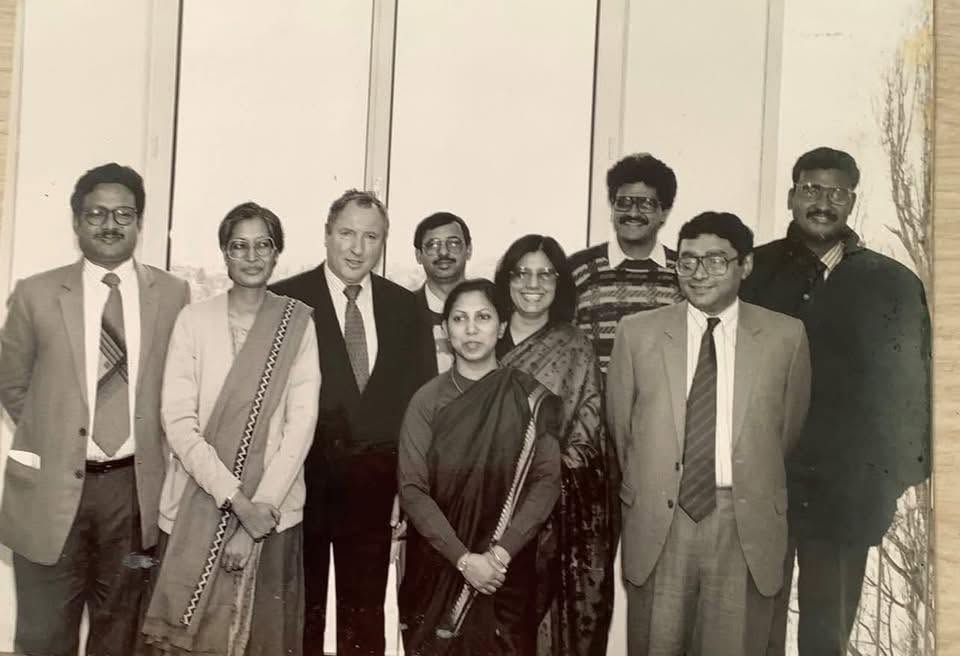
The first time I met Dasgupta in person was during a visit to Germany. A group of Indian journalists had been invited to understand the process of German reunification. We travelled through both eastern and western parts of the country.
One of the most memorable experiences of that visit was an exhibition of paintings that Adolf Hitler had denounced as “degenerate art”. During the Third Reich, many such works had been destroyed and several artists persecuted, imprisoned or killed. The exhibition was both moving and unsettling.
The following day, Dasgupta sat down to write a column on the exhibition for the magazine Sunday. He showed me the handwritten copy. It was written on high-quality German A4 paper. What struck me immediately was his handwriting. Each letter was perfectly formed, rounded and distinct. The script had an elegance that reflected discipline without stiffness. Smiling, he remarked that his handwriting had remained virtually unchanged since his schooldays.
This was long before the Internet transformed journalism. Once the article was completed, he sent it to Kolkata by fax. Later, when I saw the published version, I realised that not a single word had been altered.
Years later, I found myself working with Swapan Dasgupta at The Indian Express. I had joined the newspaper within a month of H.K. Dua’s arrival as Editor-in-Chief. Roughly a year later, Dua left and Shekhar Gupta assumed the position. He brought Dasgupta to head the editorial page, and my responsibilities included writing editorials.
On one occasion, I wrote an article arguing that although Mary Roy’s legal battle had succeeded in overturning the discriminatory Christian succession law in Kerala, its benefits had not translated into meaningful improvements in the lives of ordinary Christian women. I submitted the piece to Dasgupta.
He glanced through it and casually remarked that he would read it in the newspaper the next day. I reread the article several times, worried that some grammatical error might have escaped my attention.
The article elicited a furious response from Mary Roy herself. In her letter, she described me as a “male chauvinist pig”. Dasgupta allowed her rejoinder to be published in full. I believed then, and still do, that the letter exposed more about her intolerance of criticism than it did about my alleged prejudices.
One of Dasgupta’s admirable qualities was the absence of professional jealousy, a weakness not unknown in journalism. He encouraged younger colleagues and gave them space to grow. He allowed me to write at least two major signed articles every month, even when my views differed sharply from his own political convictions.
He also possessed the rare editorial gift of restraint. He did not rewrite articles merely to leave his imprint on them. Instead, he made minimal but meaningful changes that strengthened the argument while preserving the writer’s voice.
About a year later, he left The Indian Express to join India Today. There was considerable speculation about who would replace him. A few names were discussed and some individuals were even interviewed.
Unknown to me at the time, Dasgupta had recommended my name to Shekhar Gupta. One day, he called me into his office and showed me the letter he had written, expressing confidence that I could handle the responsibility. Thanks in no small measure to his generosity, I remained in charge of the editorial page for the next five or six years. It is a debt of gratitude I have never forgotten.
The last time I met him was in Chandigarh. By then, I had joined The Tribune and he was accompanying L.K. Advani on one of his yatras. It was evident that his interests had moved beyond observing politics from the sidelines. He wanted to participate directly in shaping events.
Life has now brought him to a position of immense responsibility. Journalism trained him to analyse, Parliament gave him legislative experience, and electoral politics provided him with a practical understanding of public life. The Finance Ministry will demand all these qualities and more.
As someone who has known Swapan Dasgupta as a writer, editor, mentor and political traveller, I wish him every success as he assumes one of the most consequential responsibilities in government. May he justify the confidence reposed in him and serve the people of West Bengal with distinction.
Writer Mr AJ Philip is Senior Most Journalist of India.He has worked in many national & International Media houses such HIndustan Times,Indian Express & many more than four decades .He may be contacted at ajphilip@gmail.com
