
Govt Approves Better-Quality Rice Under PMGKAY
Over 80 crore beneficiaries to receive rice with lower broken grain content under phased rollout from KMS 2027–28

GG News Bureau
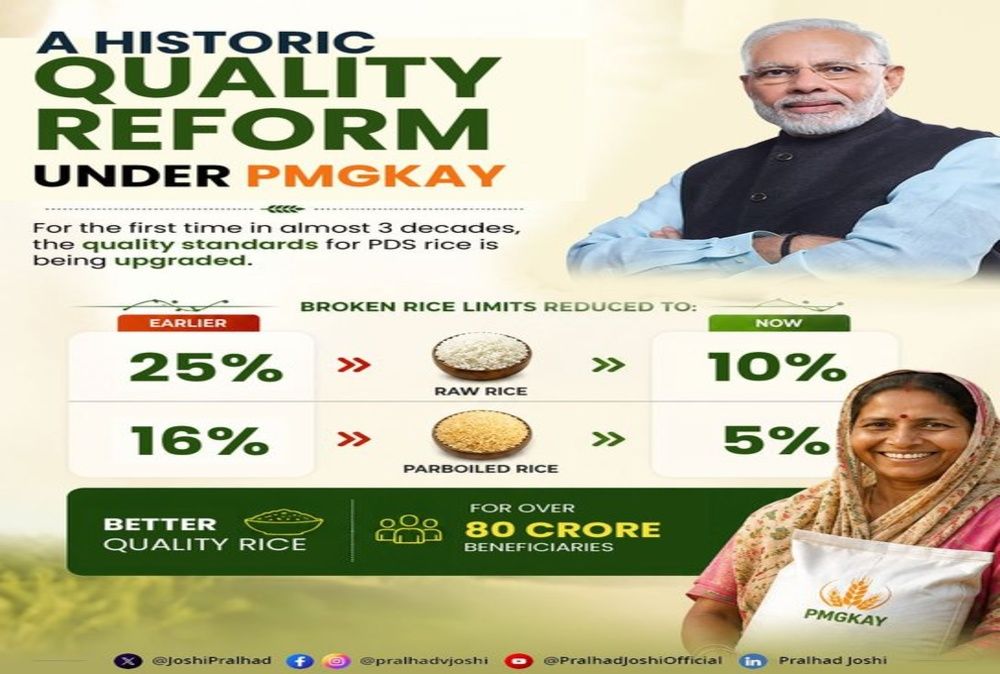
New Delhi, 3rd July: The Cabinet Committee on Economic Affairs (CCEA) on Thursday approved a major reform to improve the quality of rice distributed under the Pradhan Mantri Garib Kalyan Anna Yojana (PMGKAY) and other welfare schemes, benefiting more than 80 crore beneficiaries across the country.
Under the new policy, the permissible broken grain content in raw rice supplied through the Public Distribution System (PDS) has been reduced from 25 per cent to 10 per cent, while parboiled rice will now contain a maximum of 5 per cent broken grains, down from the existing 16 per cent.
The government said procurement of the improved-quality rice will begin immediately, with a phased nationwide rollout across procuring states by the Kharif Marketing Season (KMS) 2027–28. Distribution under PMGKAY and other welfare schemes will also be implemented in phases to ensure a smooth transition.
The Centre said the reform is aimed at improving grain quality, appearance and consumer acceptance without altering beneficiaries’ existing entitlements. Broken rice separated during milling will be diverted for other productive uses instead of being supplied through welfare schemes.
According to the government, the move is expected to generate annual savings of around ₹2,161 crore through lower transportation, storage and packaging costs, while the sale of broken rice will also help reduce the food subsidy burden.
The reform, successfully piloted in Haryana, Andhra Pradesh, Punjab, Odisha, Telangana and Chhattisgarh, also introduces QR code tagging of rice bags to enable end-to-end traceability, improve inventory management and strengthen transparency in the Public Distribution System.
The government said the initiative marks a significant step towards providing not just food security but better-quality food to millions of beneficiaries while improving operational efficiency and fiscal prudence.
