
VP Radhakrishnan Launches Sovereign AI Stack ‘Gnani Artha’
Evon 3.3 and Plexus aim to strengthen India’s AI capabilities and technological self-reliance

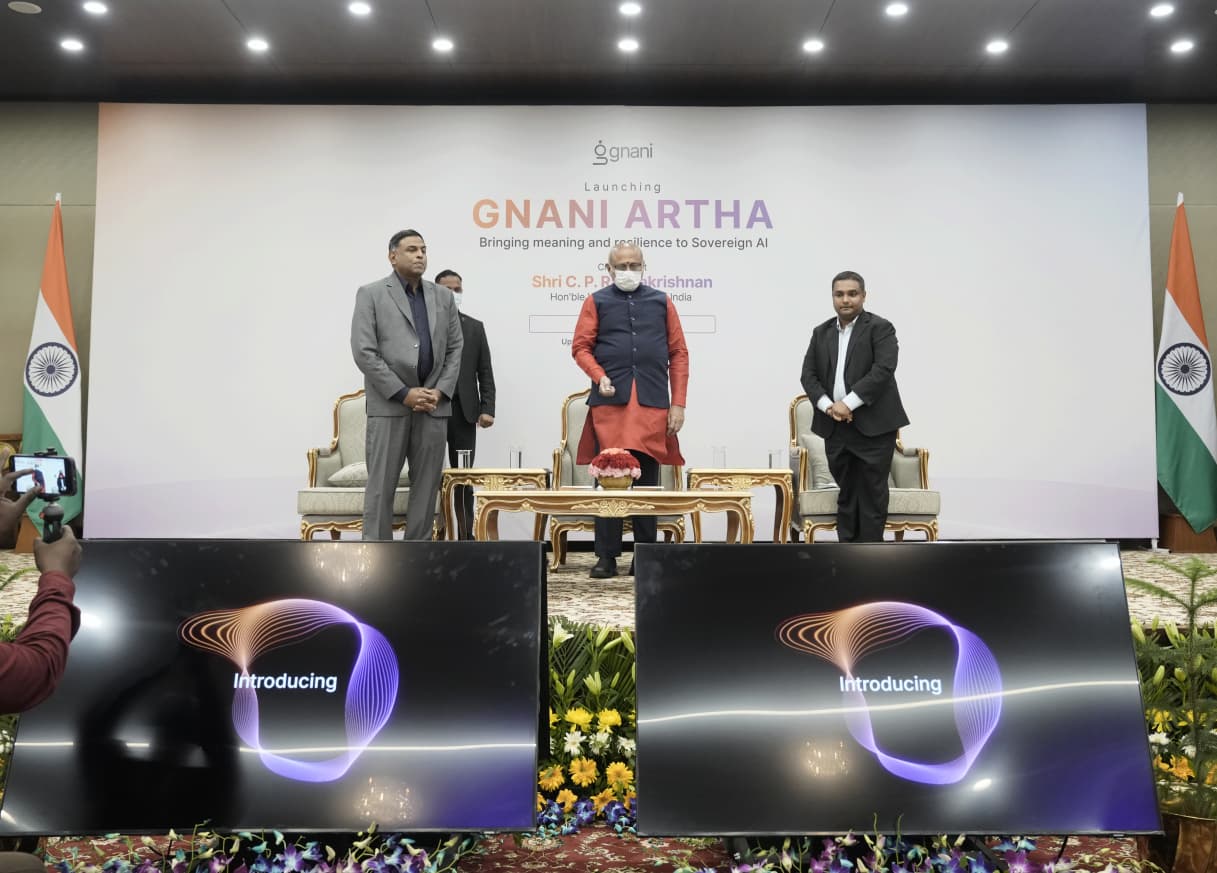
- Vice President C. P. Radhakrishnan launched Gnani Artha at Uprashtrapati Bhavan, New Delhi.
- The sovereign AI stack comprises Evon 3.3, a large language model, and Plexus, an AI-to-work platform.
- Radhakrishnan said AI could create new employment and growth opportunities for India.
- He stressed the need for India to build indigenous technology rather than remain only a technology consumer.
GG News Bureau
New Delhi, 29th Aug: Vice President C. P. Radhakrishnan on Friday launched ‘Gnani Artha’, a sovereign AI stack comprising Evon 3.3 and Plexus, developed by GNANI AI, at Uprashtrapati Bhavan in New Delhi.
Evon 3.3 is a large language model, while Plexus is a platform designed to connect AI intelligence with real-world work and institutions.
Welcoming the launch, Radhakrishnan said the combination demonstrated the growing strength of India’s technology ecosystem and showed that Indian engineers can build frontier technologies rather than merely use them.
The Vice President said technological progress has transformed significantly from the era of typewriters and limited computer use to the present age of artificial intelligence and large language models.
Recalling earlier concerns that computers could replace jobs, he said the growth of the IT sector instead created employment opportunities in India and abroad. He expressed confidence that AI would similarly open new avenues for employment and economic growth and help take India’s economic progress to the next stage.
Radhakrishnan highlighted initiatives such as the IndiaAI Mission and Centres of Excellence for AI as drivers of India’s technological transformation. He attributed much of the momentum to Prime Minister Narendra Modi’s leadership, political will and ‘India First’ approach.
Focus on technological self-reliance
The Vice President emphasised the importance of sovereign AI capabilities for strengthening India’s technological and strategic autonomy.
Referring to the use of AI in Parliament, he said the Digital Sansad portal allows parliamentary debates and papers to be accessed in multiple Indian languages. He added that simultaneous AI-based interpretation in eight languages was introduced during the recently concluded Session and would soon be extended to all Scheduled Languages.
Radhakrishnan stressed that India should move beyond being a consumer of technology and develop technologies for wider global use.
“We should not be consumers always; we need to create, so that others can consume,” he said.
He also referred to semiconductor manufacturing as another area where India needs stronger indigenous capabilities, saying the sector has gained renewed momentum under the Modi government.
The Vice President described technological capability as an important pillar of India’s journey towards Viksit Bharat @ 2047 and said Gnani Artha forms part of the broader effort towards technological self-reliance, innovation and global leadership.
He congratulated GNANI AI CEO Ganesh Gopalan and Co-Founder and CTO Ananth Nagaraj on the launch and expressed hope that the initiative would contribute to a stronger and technologically empowered India.
