By Anjali Sharma
WASHINGTON – India, the US and 8 other countries on Monday have signed the San Francisco Declaration to protect sensitive technologies and critical infrastructure supporting artificial intelligence supply chains, with 5 proposed working groups aimed at turning their shared commitments into coordinated action.
The agreement identified sensitive technologies and infrastructure at risk from theft, disruption or hostile control, and calls for diversified supply chains.
The declaration, signed at the Pax Silica Founders Retreat in San Francisco, identifies technological capabilities and infrastructure whose theft, disruption or hostile control could threaten national and economic security.
The meeting was convened by Under Secretary of State for Economic Affairs Jacob Helberg, according to the US Department of State.
The declaration established two broad categories of strategic assets requiring protection: sensitive technologies and critical infrastructure supporting what the participating countries call the emerging Super Intelligence era.
Media reported that sensitive technologies include software, materials, technical knowledge, components, manufacturing inputs and production capabilities essential to SI supply chains.
The signatories recognized that the theft, illicit transfer or acquisition of such technologies by hostile actors could provide military or intelligence advantages, create undue economic leverage or threaten national and economic security.
The second category covers critical infrastructure, including ports, terminals, transport and logistics networks, communications systems, energy infrastructure and digital platforms used to coordinate supply chains.
According to the declaration, disruption or hostile control of these systems, or unauthorized exposure of data flowing through them, could cause significant harm to the participating countries’ economic functions and essential services.
The declaration also called for diversified and trusted supply chains to reduce excessive dependencies and strengthen economic resilience.
The participating countries have committed to establishing working groups to advance cooperation on technology security and economic resilience.
The US State Department identified five proposed areas of cooperation: Pro-innovation policy frameworks, Adoption of Super Intelligence across key economic sectors, Supply chain cooperation, across the SI technology stack, Safe harbours and supply chain security hubs and SI security and resilience.
The proposed groups are intended to translate the coalition’s shared objectives into practical cooperation, including stronger protection of sensitive technologies and strategic infrastructure.
The declaration also emphasized cooperation in enforcing national policies to prevent undue access, influence or control over such assets.
India formally joined Pax Silica at the India AI Impact Summit in New Delhi on February 20, 2026.
The initiative focused on securing the global technology supply chain, spanning critical minerals, semiconductor manufacturing, advanced AI systems and the infrastructure supporting their deployment.
India’s participation in the San Francisco Declaration extends that cooperation to a shared framework for protecting sensitive technologies and critical infrastructure.
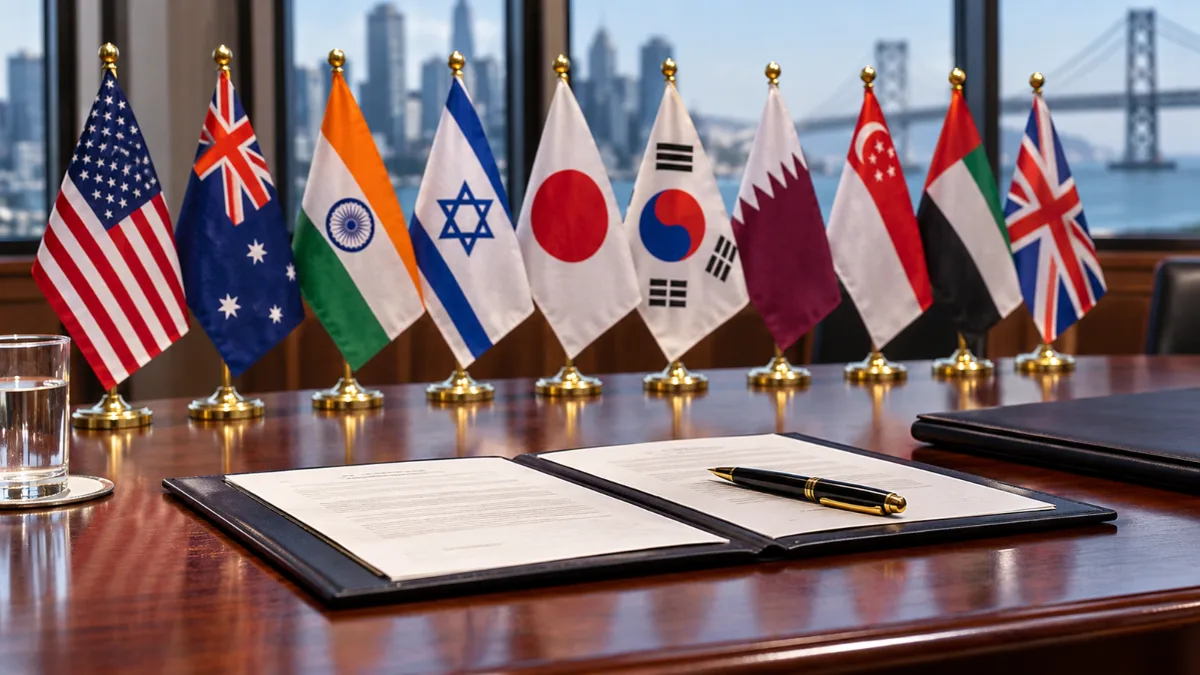
The declaration was issued jointly by ten governments: the United States, India, Australia, Israel, Japan, the Republic of Korea, Qatar, Singapore, the United Arab Emirates and the United Kingdom.
The signatories affirmed that economic security is fundamental to national security and called for coordinated efforts to address economic coercion, supply chain disruptions and non-market policies that distort competition.
They also emphasized protecting private investment, promoting innovation and maintaining mutually beneficial access to emerging technologies.
US State Department described the declaration as a new phase for Pax Silica, which was launched less than a year ago.
The agreement establishes a common understanding of the technologies and infrastructure requiring protection, while the proposed working groups provide a framework for further cooperation.
The declaration uses the term Super Intelligence, although a footnote clarifies that some participating countries use the term artificial intelligence instead.
The next phase outlined in the declaration is the establishment of the five working groups covering technology policy, adoption, supply chains, security hubs and resilience.
The declaration does not specify a timetable for their establishment or announce individual projects, funding commitments or enforcement arrangements.
The signatories have committed to protecting strategic technologies and infrastructure through cooperation while pursuing innovation and economic growth.
Intel’s shares came down by 28.6 per cent, wiped out $140 billion of market value.
Shareholders have sued Intel after accusing the chipmaker of defrauding them by concealing the impact of a prolonged slowdown in PC sales, which saw its stock price plunge nearly 29 per cent in a single day.
The proposed class action has been filed in the federal court in San Jose, California.
It was led by a Michigan pension fund, the shareholders have stated that the company was too slow to disclose information on how slowing PC sales and an inventory glut would weigh on revenues media reported.
It has been claimed that the company’s problems with PC sales as well as excess inventory outweighed data center construction and other benefits in connection with the artificial intelligence boom.
They alleged that Intel had the motive and opportunity to defraud by raising capital in mid-August, halfwaythrough its “disastrous” third quarter when the company sold $23 billion of stock at $95 per share.
This came as the company looked forward to build its chip contract manufacturing business – a major part of Chief Executive Lip-BuTan’s business strategy.
Intel’s shares came down by 28.6% wiping out $140 billion of market value.
It happened a day after the company projected lower-than-expected fourth-quarter revenue and profit, besides predicting a prolonged slowdown in PC sales.
Tan spoke to analysts, expressed disappointment over manufacturing supply shortages, an “unprecedented memory crunch,” and resulting softness in PCs.
He added “We need to address these challenges with urgency.”