

By Anjali Sharma
UNITED NATIONS – World leaders on Thursday approved a new declaration as Sea level rise is among the most visible consequences of global warming, but for some countries, it is an imminent existential threat as they debate the best ways to strengthen international cooperation and support vulnerable low-lying nations most at risk.
World leaders approved the UN Declaration on Sea Level Rise, which Member States finalised last month
According to the UN Intergovernmental Panel on Climate Change the global mean sea level is on the rise around the world and accelerating.
Over.770 million people live in coastal areas affected by sea level rise.
It noted that a half-metre rise in sea levels by the end of the century could force between 150 million and 300 million people from their homes
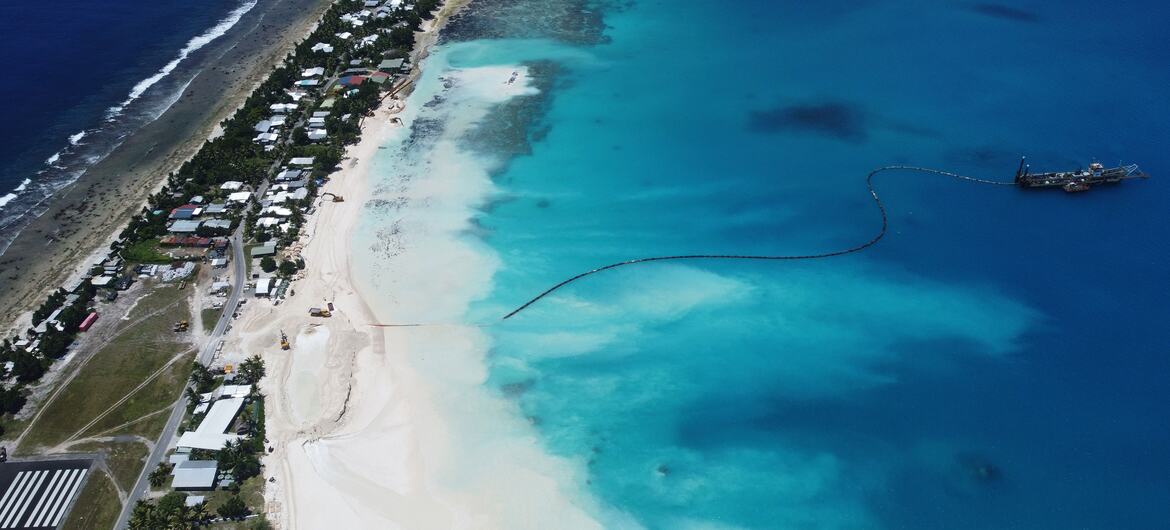
Some small island States are already planning to be swallowed by the sea, with Tuvalu transitioning to become the world’s first “digital nation”
Nations contributing least to such climate change consequences as sea level rise are facing the worst impact
The General Assembly held a high-level meeting on rising sea levels on the margins of the high-level debate, the meeting aimed to address the existential threats posed by this phenomenon.
The meeting aims to renew high-level political attention to sea level rise as a cross-cutting issue that implicates climate action, sustainable development, peace and security, human rights and international cooperation.
The aim is to shift the international response to the phenomenon from fragmented initiatives towards sustained, coordinated and adequately financed action.
UN head António Guterres warned that sea level rise is accelerating and threatening the futures of coastal communities, as he opened the high-level event.
In 2024, global sea levels rose by almost six millimetres, the largest annual increase ever recorded.
He said without drastic emissions cuts, they could rise by a metre by the end of the century.
Some 770 million people live less than five metres above the high-tide line, he said.
Rising waters threaten homes, food systems, infrastructure and even the territorial integrity of some nations. Those who contributed least to climate change face the greatest danger.
He called for action on three fronts: cutting emissions, protecting communities and closing legal gaps.
Global emissions must peak immediately and fall 60 per cent by 2035, while adaptation finance must triple. Governments should build resilience into planning, expand early warning systems and involve affected communities in decisions.
He also urged legal clarity on Statehood, maritime boundaries and the rights of people displaced by rising seas. Welcoming negotiations on a United Nations declaration on sea-level rise, he called for that work to produce concrete action.
“The SOS has gone out,” he said. “The world must answer.”
Francisco Carvalho, Prime Minister of Cabo Verde and co-facilitator of the UN Declaration on Sea Level Rise, said the text’s approval by consensus shows that multilateralism still works and that countries can find common ground to protect their collective future.
Sea level rise is “neither a distant threat nor a theoretical concern” for his country, he said.
For Small Island developing States, it is a question of preserving their “historical and cultural identity deeply rooted in the land and the sea”.
The Declaration calls for stronger adaptation and recognizes sea level rise as a matter of justice, human rights and peace.
“A sustainable future cannot be built if the most vulnerable are left behind,” he added.
Goodwin Friday, Prime Minister of Saint Vincent and the Grenadines welcomed the approval of the Declaration, said sea level rise is not “simply environmental, but a developmental, economic and humanitarian concern that demands collective action.”
He said with 85 per cent of the country’s population and 90 per cent of its critical infrastructure concentrated along a narrow coastal belt, national adaptation planning puts resilience at the centre of development.
“Investing in resilience now is more cost-effective than paying the far greater price for loss and damage later,” he added.
He urged States to match their determination with finance at the scale and speed the challenge demands.
Costas Kadis, European Commissioner for Fisheries and Oceans, said 30 countries had pledged $250 million as he cited the recent launch of the Global OceanEye Alliance by the European Commission and Canada to support ocean observation .
Finance must be predictable, accessible and better aligned with the needs of countries and communities at risk, he said.
Climate funds and the private sector should work together to avoid parallel efforts and missed opportunities.
“Our response must put people and communities first,” he said.
He called for their involvement in decisions affecting their future. Cooperation must also be grounded in science and sustained by effective financing, he added.
Sea level rise is accelerating, he said. “But, while the threat is shared, the burden is not.”
Khalilur Rahman of Bangladesh, President of the General Assembly, warned, with around 900 million people living in low-lying coastal zones and more than 1 billion potentially exposed to coastal hazards by 2050.
“Sea level rise does not respect borders,” he said. “But, while the threat is shared, the burden is not.”
He said that countries with the fewest resources often face the greatest risks.
Between 1970 and 2020, small island developing States lost $153 billion to climate hazards, more than 10 times their average annual gross domestic product. Behind those figures are lost homes and livelihoods.
He called prevention and preparedness among the most cost-effective investments available, he urged States to turn the Political Declaration into practical action.
Developing countries will need an estimated $310 billion to $365 billion annually for adaptation by 2035 yet international public adaptation finance totaled just $26 billion in 2023. That gap, he said, tests international solidarity.
He called for predictable, accessible and concessional finance, adequate resources for the Fund for Responding to Loss and Damage and solutions to debt pressures.
The Declaration is a promise to future generations, he said, urging greater coordination and ambition.
Surangel Whipps Jr. President of Palau, spoke on behalf of the Alliance of Small Island States said “For States that are literally defined by the ocean around us, the impact of sea level rise will be life-altering,”
Sea level rise threatens their people’s well-being, cultures and ecosystems, he said. Compounding those threats is the “unfairness of the situation”: “The climate crisis is not of our making.”
Small Island developing States have sounded the alarm since the 1989 Malé Declaration on Global Warming and Sea Level Rise and helped develop international law on the issue, he said.
He welcomed today’s declaration as “a genuine achievement”, while stressed that it is “far from the end of our journey”.
Matthew Samuda, Minister for Water, Environment and Climate Change of Jamaica, spoke on behalf of the regional group said that sea level rise “is not a distant projection, it is a lived and worsening reality” for the Caribbean Community and other small island developing States.
“The sea is not merely approaching our doorsteps, it is already there,” he said.
He pointed to eroding shores and saltwater contamination of freshwater and soil. A half-metre rise could destroy 38 per cent of Caribbean beaches, with serious consequences for tourism revenue.
Matthew Samuda welcomed the Declaration’s recognition that maritime zones and Statehood can endure despite sea level rise.
“These are not technical matters,” he said. “They are safeguards for sovereignty, security, livelihoods and identity.”
The Declaration must now lead to sustained action, he said.
He called for protection for those most affected and cooperation across climate, ocean, human rights and development efforts. Financial support must be “timely, predictable, accessible and grant-based”, without adding to countries’ debt.
Centuries of living below sea level have shaped the European part of the Netherlands, its representative said.
The country’s Caribbean islands face a different reality, but the same immediate threat: retreating beaches, ecosystems under pressure and growing risks of flooding, erosion and storm surges.
Caribbean Sea levels are projected to rise by 20 centimetres by 2050 and by 50 to 80 centimetres by 2100, he said.
The Netherlands stands ready to share its knowledge of water management, coastal protection and freshwater security.
“The sea is patient it takes a little more each year. And what it takes, it does not easily return. We cannot afford to be patient in return,” he said.
The representative of the Marshall Islands was speaking on behalf of the Pacific Islands Forum welcomed the Declaration as evidence that Pacific countries have helped shape the international response to sea level rise.
Its affirmation that maritime zones can remain in place despite shifting coastlines reflect a solution long advanced by the region, he said.
The Pacific has sounded the alarm on rising seas for more than three decades, he recalled.
The Declaration is an important step, but countries must follow it with stronger adaptation measures, better disaster preparedness and new financial commitments to help communities confront the growing threat.
The representative of Yemen said that Sea level rise has become a reality threatening coastal communities.
She stressed that these challenges add to the already “extremely difficult humanitarian circumstances” faced by her country.
Yemen is affected by rising seas due to its long coastline and dependence on ports and fisheries.
Yemen faces grave repercussions from climate change, she pointed out that her country is among those “least responsible for international emissions”.
She called for increased adaptation finance and support for developing countries to collect and analyse data so that resources can be directed to where they are needed most.
“Adaptation is not an option that can be postponed for the least developed countries,” she said.
She urged “real international partnership” to help Yemen protect its coastal communities, bolster its water and food security and strengthen resilience.
Phillipinnes envoy said “For archipelagic and climate-vulnerable nations like the Philippines, sea level rise is not a distant threat”.
He added “It is already eroding our coastlines, salinizing our lands, threatening our livelihoods and placing communities at increasing threat of displacement.”
The representative underscored that “the stakes are especially high” as parts of the Philippines are experiencing rising seas at rates significantly above the global average he pointed out that the science is clear.
“Incremental measures alone will not be enough,” he stressed, calling for transformative adaptation through scaled-up nature-based solutions.
“Coastal ecosystems provide natural defences against storm surges and flooding while sustaining livelihoods and biodiversity,” he said.
He urged that mangroves, wetlands and seagrasses be protected and restored.
The representative of Iceland noted that her country is actively engaged in efforts to clarify the legal consequences of sea level rise, guided “both by empathy and by resolve”.
Iceland representative said Iceland is committed to ensuring that international law protects the continuity of States affected by the phenomenon, as well as to preserving the outer limits of maritime zones duly established by the 1982 UN Convention on the Law of the Sea.
“The present Declaration is a milestone, but it is not the finish line,” she stressed. And, as the response to rising seas is a “shared international responsibility.”
She said that every State must play its part, including by redoubling efforts to address its root cause of climate change.
“Climate change is the common concern of humankind,” she stated.
Indian deletaion said “India has a long coastline of over 11,000 kilometres, and many depend on the ocean for their food and livelihood,” that country’s representative, welcoming the emphasis in today’s Declaration on the need to “act now”.
He said that India understands the concerns of small island developing States and low-lying coastal nations that face the immediate consequences of rising sea levels.
He spotlighted India’s National Coastal Mission Scheme, established in 2017, which is intended to strengthen the country’s resilience to rising seas through early warning systems, scientific risk assessments and the restoration of natural coastal barriers.
In that context, he also highlighted the practical support provided by international organizations such as the Coalition for Disaster Resilient Infrastructure.
“Sea level rise is no longer a distant threat it is a reality that is here,” stated the representative of Peru.
For Peru, the security of its population, the resilience of its infrastructure, the sustainability of its economy and the protection of its coastal and maritime ecosystems are all at stake.
He called for stronger science, prevention and resilience, including early warning systems that help anticipate risk and incorporate the phenomenon into planning for coastal areas.
He also underscored the importance of protection and adaptation with nature-based solutions playing “a key role” as well as timely financing, access to technology and capacity-building for developing countries.
“Sea level rise is a global challenge that demands a collective response,” he emphasized.
He called for “more cooperation, more financing, more science and more protection for the most vulnerable communities”.
“We transition from acknowledging a looming geographical hazard to systematically managing an existential global crisis,” declared the representative of Romania.
Romanian delegation reiterated her country’s belief that peace and development are impossible without the rule of law.
In that context, she spotlighted the importance of the International Court of Justice, as “we believe that legal predictability is the ultimate safeguard for all nations, large and small”.
She spotlighted the Court’s 2025 advisory opinion on climate change a historic measure to “clarify the legal consequences of climate change and the obligations of States” —
Romania added that the International Law Commission’s final report on the issue also offers legal clarity.
She joined others in urging the international community to focus on legal certainty, regardless of physical coastal changes; science-driven adaptation anchored in advanced marine data; and support for the most vulnerable States.
“These are not political statements they must be backed by financing frameworks in threatened coastal zones,” she emphasized.
The representative of Lesotho said “What happens to the world’s oceans affects our high-altitude wetlands, our seasonal rainfall and the health of our water networks.”
He said that Lesotho is landlocked, he said that his country’s mountain ecosystems are intrinsically linked to the global hydrological cycle.
“The climate crisis and global air circulation operate as a single borderless system, which neither knows nor respects any boundaries,” he emphasized.
He underlined the importance of multilateral cooperation, he said that today’s Declaration must prioritize accessible climate finance, data-driven decision-making and systemic resilience.
The international community should approach intergovernmental negotiations with “deep accountability and a shared resolve”, he urged, reaffirmed Lesotho’s commitment to working with global partners on this issue.
The representative of the United Arab Emirates voiced solidarity with small island developing States and coastal communities facing rising sea levels.
He urged accelerated implementation of the Paris Agreement and the outcomes negotiated at the 2023 UN Climate Change Conference “with regard to 1.5°C, depending on the conditions and abilities of different countries”.
She also underlined the need for funds and multilateral banks to provide necessary funding to vulnerable countries without exacerbating their debt burdens.
She spotlighted her country’s pledge of $100 million to the Loss and Damage Fund, made during the 2023 Conference.
UAE representative called for accurate data exchange on the dangers facing coastal regions.
“In the Gulf area, we are facing special pressures in the field of rising temperatures and increasing salination, and we support early warning systems as well as the attention to sovereignty and territorial integrity of affected States,” she said.
Mexico rep said “For Mexico, sea level rise is not an abstract forecast,”
He noted that it is already transforming Mexico’s coasts and affecting the livelihoods of its citizens.
“How do we protect not just our territory, but communities, cultures and the ways of life that give meaning to this territory?”
Mexico has 11,000 kilometres of coastline, highly exposed to coastal erosion and extreme climate events, he stated.
He illustrated the human impact, spotlighted the state of Tabasco, which lies along the Gulf of Mexico.
He noted “the fishing community of El Bosque saw how the sea gradually swallowed homes, streets and community spaces”.
As a result, he said that “families had to resettle through a process in which communities, Government and civil society participated”.
The experiences such as this demonstrate that “effective adaptation cannot merely depend on infrastructure or technology”, he said.
He underlined the importance of “critical knowledge, participation, appropriation and trust”.
“What is being lost cannot be measured merely in square kilometres,” he observed, which is why Mexico advocates for a human-centred response to sea level rise that prioritizes the human rights of people in vulnerable situations.
