
Trump, Xi hails warmer US-China ties, ‘Never gotten along better’ Free Tibet’ chants heard outside WH

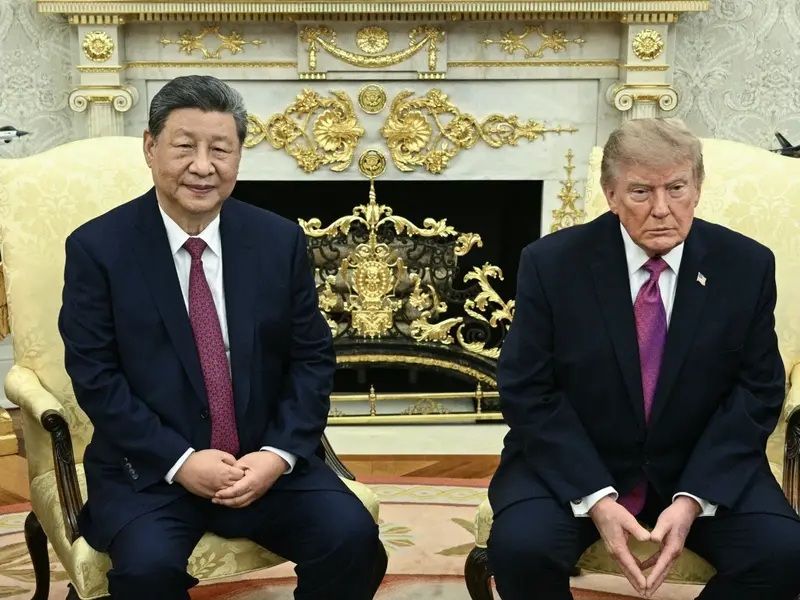
By Anjali Sharma
WASHINGTON – US Presdident Donald Trump on Thursday presented the Chinese president Xi Jinping with a bald eagle statue at 134-guest dinner attended by prominent technology executives, media reported.
Xi said their talks had produced a “common understanding on many issues”.
US-China warmth carefully choreographed unfolded inside the White House on Thursday night as Trump and Xi toasted a stronger relationship at the State dinner.
The protesters chanted for a free Tibet and Hong Kong can be heard outside the White House and told the Chinese leader he was “not welcome”.
Xi high-profile state visit to Washington came where Trump declared that the two nations had “never gotten along better” and Xi called on both sides to give their relationship “new substance” and “new strategic guidance”.
The White House had rolled out an elaborate welcome for Xi and his wife, Peng Liyuan, during a visit that included a formal arrival ceremony, the talks between the two leaders and a state dinner.
Trump acknowledged the differences between the political systems of the both countries but put the emphasis on cooperation at the State dinner.
He said “As the leaders of our two nations, President Xi and I both understand that we represent different systems, but the ties between our people endure, and we’ve never gotten along better.”
Trump said the exchange of goods, knowledge, customs and ideas had helped build commerce and mutual respect between the countries.
He called for a relationship that promotes prosperity and security for future generations.
Xi said his exchanges with Trump had produced a “common understanding on many issues”, though he did not identify those issues or announce a specific agreement in his toast.
He said his discussions with Trump had brought “new substance” and “new strategic guidance” to bilateral ties.
Xi also sought to cast the two leaders’ domestic ambitions as compatible.
He referred to Trump’s “Make America Great Again” agenda and China’s pursuit of what he called “great national rejuvenation”, he said the goals could be “mutually reinforcing”.
Xi stated that “China and the United States must act as responsible major countries, meet the expectations of our peoples, keep pace with the trend of our times, and explore a new approach for major countries to get along with each other,”.
Trump presented Xi with a statue of a bald eagle, the national symbol of the US and said he hoped it would find “a nice place, a wonderful place in Beijing”.
The White House also used the dinner to evoke the history of US-China diplomacy.
The official menu featured Schramsberg Blanc de Noirs, chosen in reference to the sparkling wine served during the 1972 Nixon-Zhou Enlai “Toast to Peace”.
The décor leaned heavily on red, which the White House said was selected for its longstanding cultural significance in China. Red linens, dahlias and ranunculus featured in the East Room arrangements.
The guests were Apple CEO Tim Cook, Nvidia CEO Jensen Huang, Elon Musk and AMD CEO Lisa Su. The pool put the number of guests at 134.
The protesters gathered outside the White House gates and chanted “Free Hong Kong”, “Free Tibet”, “CCP, you’re not welcome” and “Xi Jinping, you’re not welcome”.
The chants could be heard from the North Portico, where members of the White House press pool were waiting.
Demonstrators also called for the release of political prisoners and jailed Hong Kong media publisher and democracy advocate Jimmy Lai.
The White House protest formed part of a wider series of demonstrations planned by Tibetan, Uyghur, Hong Kong, Taiwanese, Southern Mongolian and Chinese democracy groups during Xi’s visit, media reported.
Protests were also planned outside the Chinese Embassy in Washington D.C., at the US Capitol and at Franklin Park.
Tibetan organizers said hundreds of demonstrators were prevented from reaching International Drive despite securing a permit for a protest outside the Chinese Embassy.
They said protesters were stopped at Van Ness Street after security measures and road restrictions.
Tibetan Youth Congress President Tsering Chomphel said “We secured all the necessary permits and followed every requirement asked of us.”.
“This is a peaceful gathering. Tibetans came here today to exercise the fundamental right to peacefully protest, and we should be allowed to do so at the location for which we received permission.”
The organisers said their Metropolitan Police Department permit allowed up to 2,000 participants, amplified sound and a march beginning at 3505 International Drive.
The International Campaign for Tibet alleged that groups welcoming Xi had been able to gather outside the White House while Tibetan demonstrators encountered restrictions near the Chinese Embassy.
Capital Area Tibetan Association President Tenzin Norbu said the situation raised concerns about whether other planned demonstrations would be able to proceed.
Ryan Fioresi, executive director of the International Campaign for Tibet, alleged that Chinese individuals were recording Tibetan protesters.
“These are Americans. They are Tibetan Americans exercising their rights on American soil, and they have every right to peacefully protest,” Fioresi said.
“Tibetans should not have to fear surveillance or intimidation for speaking out in the United States.”
Protesters also sought the release of the 11th Panchen Lama and other Tibetan political prisoners.
They called for renewed dialogue between Chinese authorities and Tibetan representatives and an end to policies they allege are eroding Tibet’s religious, cultural and linguistic identity.
Xi’s message inside the White House remained firmly focused on rebuilding ties.
He invoked the history of Chinese-American cooperation during World War II and the ping-pong diplomacy that preceded the normalisation of relations.
Xi called on the two countries to “write a new chapter in our friendly relations”, while Trump raised his glass to a future of “harmony, peace, and success” for their peoples.
The visit reflects an intensified period of direct engagement between the leaders. Xi’s September 23-25 trip followed Trump’s visit to China earlier this year.
Trump also showed Xi the White House’s new South Lawn helipad. The White House published video of the tour on Thursday.
Trump or Xi neither used the dinner remarks to spell out how the “common understanding” Xi referred to would translate into specific agreements.
