
BRICS Education Ministers Adopt Bhubaneswar Declaration
Pralhad Joshi calls for people-centric, humanity-first education cooperation as BRICS nations agree on five priority areas.

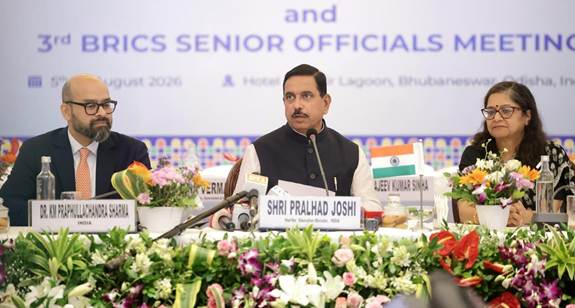
- 13th BRICS Education Ministers’ Meeting concludes in Bhubaneswar.
- Ministers adopt a declaration covering five priority areas in education.
- India stresses innovation, human values and traditional knowledge systems.
- BRICS members back cooperation on AI, skills, research and academic mobility.
GG News Bureau
BHUBANESWAR, 7th Aug: Union Education Minister Pralhad Joshi on Friday reaffirmed India’s commitment to a people-centric and humanity-first approach to BRICS cooperation as the 13th BRICS Education Ministers’ Meeting concluded in Bhubaneswar with the adoption of a joint declaration.
Chairing the meeting, Joshi said education systems must continuously evolve to meet the aspirations of future generations while remaining firmly rooted in human values.
Referring to India’s BRICS Chairship 2026 theme, “Building for Resilience, Innovation, Cooperation and Sustainability,” he said learners, teachers, researchers and young people should remain at the centre of policymaking and international cooperation.
Joshi described education as the foundation of inclusive growth and shared prosperity and said the declaration reflected the collective commitment of BRICS countries to deepen cooperation.
He also stressed preserving and promoting traditional and indigenous knowledge systems, arguing that innovation and heritage complement each other.
BRICS Agrees on Five Education Priorities
The declaration outlined a shared roadmap across five priority areas identified under India’s Chairship.
BRICS members agreed to strengthen Early Childhood Care and Education (ECCE) and foundational literacy and numeracy, including through age-appropriate digital learning solutions.
On skill development, the countries recognised the role of the BRICS TVET Cooperation Alliance and acknowledged India’s initiative to undertake an International Skill Gap Study with voluntary participation by interested members.
The declaration also called for greater joint research, stronger start-up ecosystems and the safe, ethical and human-centred use of Artificial Intelligence in education.
Members agreed to continue discussions on mutual recognition of qualifications to facilitate greater academic mobility and cooperation.
BRICS countries also supported capacity building through the Rectors’ Forum, faculty and leadership exchanges, STEM-focused scholarship programmes and exploratory work towards a BRICS University Global Ranking and Evaluation System.
The meeting welcomed India’s initiative on guiding principles for strengthening academic cooperation on traditional and indigenous knowledge systems.
Delegations from Brazil, Russia, China, South Africa, Indonesia, Iran, Ethiopia and the United Arab Emirates attended the meeting.
India is scheduled to host the 18th BRICS Summit in New Delhi on September 12-13, 2026, as part of its BRICS Chairship.
