
India-EU Talks Focus on Trade, Technology
Dr Jitendra Singh calls for stronger cooperation in AI, quantum technologies, semiconductors, clean technologies and advanced research

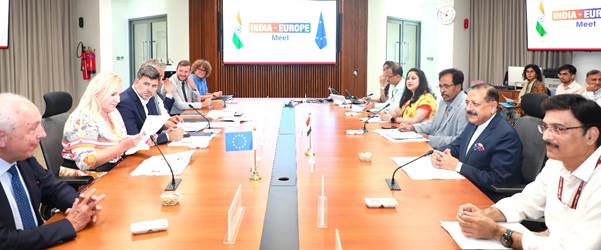
- India-EU FTA implementation discussed
- AI, quantum and semiconductor cooperation explored
- EUR 60 million clean-tech research initiative highlighted
- Horizon Europe association talks reviewed
GG News Bureau
New Delhi, 22nd Sept: A European Parliament delegation from the Committee on Industry, Research and Energy (ITRE), led by Angelika Winzig and Raffaele Stancanelli, met Union Minister of State (Independent Charge) for Science & Technology and Earth Sciences, Dr Jitendra Singh, on Tuesday for discussions on the effective implementation of the India-EU Free Trade Agreement (FTA) and deeper cooperation in science, technology, research and critical and emerging technologies.
Dr Jitendra Singh said the India-EU strategic partnership offers significant opportunities for closer cooperation in areas of mutual priority, with science and research forming an integral part of the expanding relationship.
The European Parliament delegation included Angelika Winzig, MEP from Austria; Raffaele Stancanelli, MEP and Full Member of ITRE; Mohammed Chahim, MEP from the Netherlands and S&D Vice-President; Raúl de la Hoz Quintano and Nicolás González Casares from Spain; Morten Løkkegaard from Denmark; Jüri Ratas from Estonia; and Virginijus Sinkevičius from Lithuania.
Speaking on behalf of the delegation, Angelika Winzig said India is a key strategic partner for the European Union. She said the visit was aimed at developing a deeper understanding of India’s industrial and technology policies and identifying areas for closer cooperation.
The discussions covered shared priorities including industrial competitiveness, resilient critical supply chains and the green and digital transitions. The delegation also welcomed continued dialogue between India and the European Parliament.
FTA implementation highlighted
Dr Jitendra Singh said the early and effective implementation of the India-EU FTA should remain a collective priority. He also sought continued support from the European Parliament for its early signing and ratification.
According to the Minister, the agreement would create new opportunities for businesses, consumers and skilled professionals while providing further momentum to the wider India-EU strategic partnership.
Focus on research and innovation
Dr Jitendra Singh said research and innovation remain central to the government’s vision of Viksit Bharat 2047, with emphasis on high-impact research, translating research into technologies and products, and increasing industry participation.
He referred to the Anusandhan National Research Foundation (ANRF) and the EUR 10 billion Research, Development and Innovation (RDI) initiative aimed at supporting high-risk, high-impact research and nurturing deep-tech startups.
The Minister invited greater India-EU cooperation in Artificial Intelligence, quantum technologies, advanced materials, biotechnology, semiconductors, high-performance computing and next-generation telecommunications, including 6G.
On AI, he highlighted India’s interest in applications in areas such as healthcare and science, alongside responsible and trustworthy adoption. He said quantum technologies offered opportunities for cooperation in research, applications, skills and development of the wider quantum ecosystem.
Semiconductor and clean technology cooperation
Dr Jitendra Singh said India’s expanding semiconductor and electronics ecosystem and the EU’s efforts to build resilient and secure semiconductor supply chains provide scope for cooperation in research, innovation, investment and ecosystem development.
He also called for stronger collaboration on clean and green technologies, climate and environmental challenges. Under the India-EU Trade and Technology Council, progress has been made on clean and green technology workstreams, including a EUR 60 million joint investment over four years for collaborative research on waste-to-hydrogen, marine pollution and recycling of electric vehicle batteries.
The meeting also discussed the proposed India-EU Innovation Hub on Electric Vehicle Charging Technologies and Testing, aimed at bringing together research capabilities, testing infrastructure, standards expertise and startup ecosystems from both sides.
India and the EU are also sharing knowledge on Hydrogen Valleys and working towards cooperation on hydrogen-related safety standards. Dr Jitendra Singh said cooperation in green hydrogen could support greater trade and investment, including potential green hydrogen exports from India to the EU over the medium term.
Horizon Europe association discussed
The Minister said India’s association with the Horizon Europe programme would expand opportunities for Indian researchers to work with European institutions in cutting-edge research areas.
He said discussions were progressing with substantial convergence, while some legal, financial and institutional issues remained under consideration. India, he added, remains committed to concluding the negotiations expeditiously through an arrangement that is balanced and mutually beneficial.
Dr Jitendra Singh also invited the ITRE delegation to identify areas where Indian and European research and innovation priorities could converge, particularly in joint research, technology development and scale-up.
The meeting also reviewed India’s research priorities, critical and emerging technologies, implementation and follow-up of the India-EU Trade and Technology Council, and the status of India’s association with Horizon Europe, reinforcing the scope for further engagement in science, technology, innovation and clean technologies.
