
India Pursues Zero-Tolerance Policy Against Terrorism: PM Modi
138th episode of Mann Ki Baat focuses on national security, Ashok Singhal’s birth centenary, environmental conservation, youth and local products

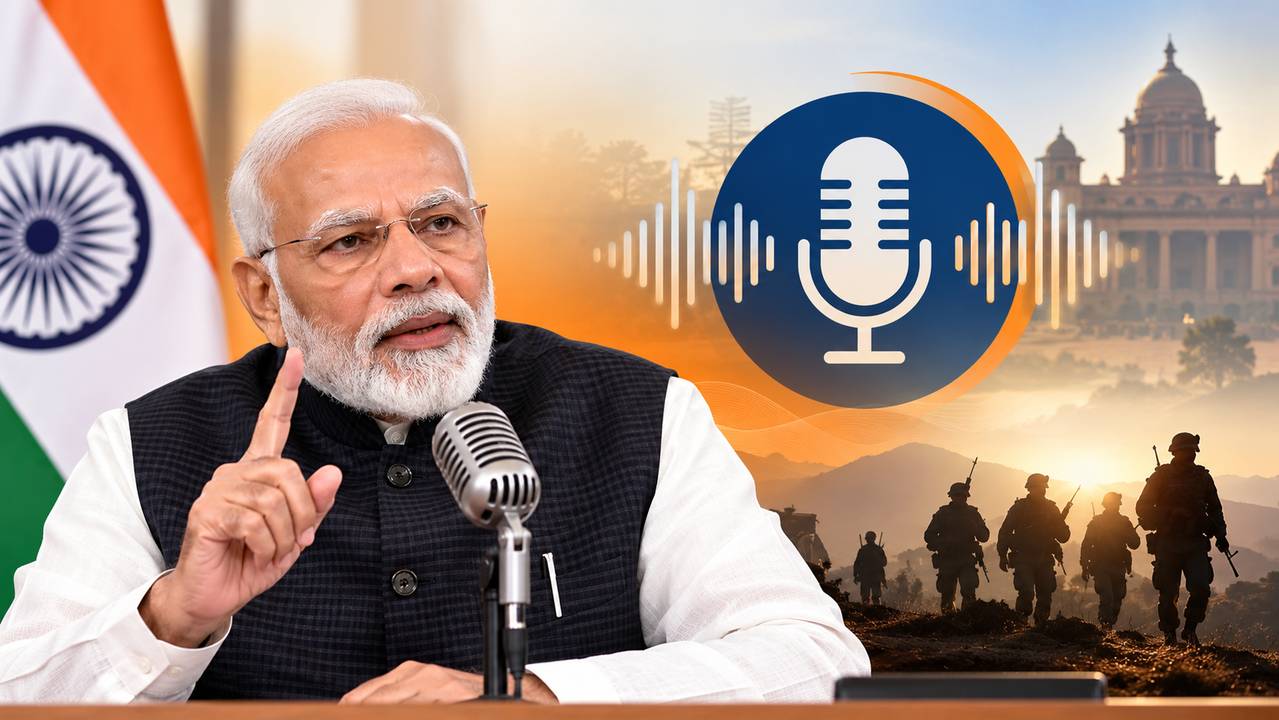
- PM Modi recalls the 2016 Surgical Strike and India’s counter-terrorism approach.
- Over 2.6 crore people have reportedly completed census self-enumeration.
- Modi pays tribute to Ashok Singhal on his birth centenary.
- Mann Ki Baat highlights conservation, drug-free youth and local enterprise.
GG News Bureau
New Delhi, 27th Sept: Prime Minister Narendra Modi on Sunday highlighted India’s counter-terrorism policy, the ongoing census exercise, the birth centenary of former Vishwa Hindu Parishad international working president Ashok Singhal and several grassroots initiatives during the 138th episode of his monthly radio programme Mann Ki Baat.
Addressing the nation, PM Modi recalled the September 28-29, 2016 Surgical Strike, when the Indian Army carried out operations against terrorist targets across the Line of Control. He said the operation demonstrated India’s approach to countering terrorism and referred to subsequent operations, including the Balakot airstrike and Operation Sindoor.
The Prime Minister also recalled the September 13, 2008 Delhi serial blasts and the 26/11 Mumbai terror attacks while speaking about India’s shift towards what he described as a zero-tolerance policy against terrorism.
Census self-enumeration
PM Modi said the first phase of the census exercise was nearing completion across states and Union territories, with data from more than 32 crore families recorded, according to his address.
He urged citizens to use the self-enumeration facility through the census portal and said more than 2.6 crore people had already submitted their details through mobile phones. He said the facility was available in Hindi and 16 other languages.
PM Modi pays tribute to Ashok Singhal
The Prime Minister also paid tribute to Ashok Singhal on his 100th birth anniversary. He recalled Singhal’s role in the Ram Janmabhoomi movement and highlighted his work against social discrimination and inequality.
PM Modi said Singhal was born on September 27, 1926, in Agra and had graduated from IIT BHU before dedicating his life to social and cultural work.
Focus on heritage and conservation
The Prime Minister recalled the history of the Somnath Temple and Modhera Sun Temple, highlighting India’s efforts to preserve its cultural heritage. He also cited Modhera’s development as a solar-powered village and encouraged citizens to visit the site.
He spoke about an initiative in Manapparai, Tamil Nadu, where A. Selvaraju has been working to identify and document ancient sculptures and temples, describing such efforts as a means of strengthening people’s connection with India’s heritage.
PM Modi also highlighted environmental initiatives, including the return of elephants to Assam’s Sonai Rupai Wildlife Sanctuary following the removal of encroachments and conservation efforts that have increased the population of the endangered pygmy hog to more than 190.
In West Bengal’s Sundarbans, he highlighted women from Jharkhali who are creating mangrove forests while generating livelihoods for themselves.
Drug-free youth campaign
The Prime Minister said millions of young people had taken pledges under the Nasha Mukt Yuva Abhiyan, a 100-week campaign involving MY Bharat volunteers, NSS members, educational institutions and social and spiritual organisations.
He urged young people to use festivals as an opportunity to support those attempting to overcome addiction and strengthen the campaign for a drug-free youth population.
Sports talent and local products
Modi highlighted the work of former hockey player and coach Rajinder Singh Senior through the Round Glass Hockey Academy in Punjab. He said the initiative focuses on identifying sporting talent in villages and improving access to coaching facilities.
He also cited the example of Pratapgarh’s amla industry in Uttar Pradesh, saying the One District One Product initiative had helped local entrepreneurs and women-led self-help groups expand the processing and marketing of amla products.
Nutrition and cultural outreach
During Nutrition Month, Modi highlighted initiatives such as Chhattisgarh’s Har Ghar Munga-Ghar Ghar Munga campaign, Gujarat’s millet-based food competition and nutrition-related efforts in Maharashtra and Mizoram.
He also spoke about the global reach of Indian cultural traditions, citing Thai devotee Panthoun Thirkhanon and the Ganesha Himal Museum in Chiang Mai, which houses more than 10,000 Ganesha idols.
PM Modi concluded by urging citizens to continue sharing inspiring local initiatives and celebrate the upcoming festivals with family and friends.
