
Rahul Gandhi’s ‘Chhatron Ki Goonj’ Meets a DUSU Reality Check
What the Delhi University results reveal — and what they do not — about Congress’ youth outreach

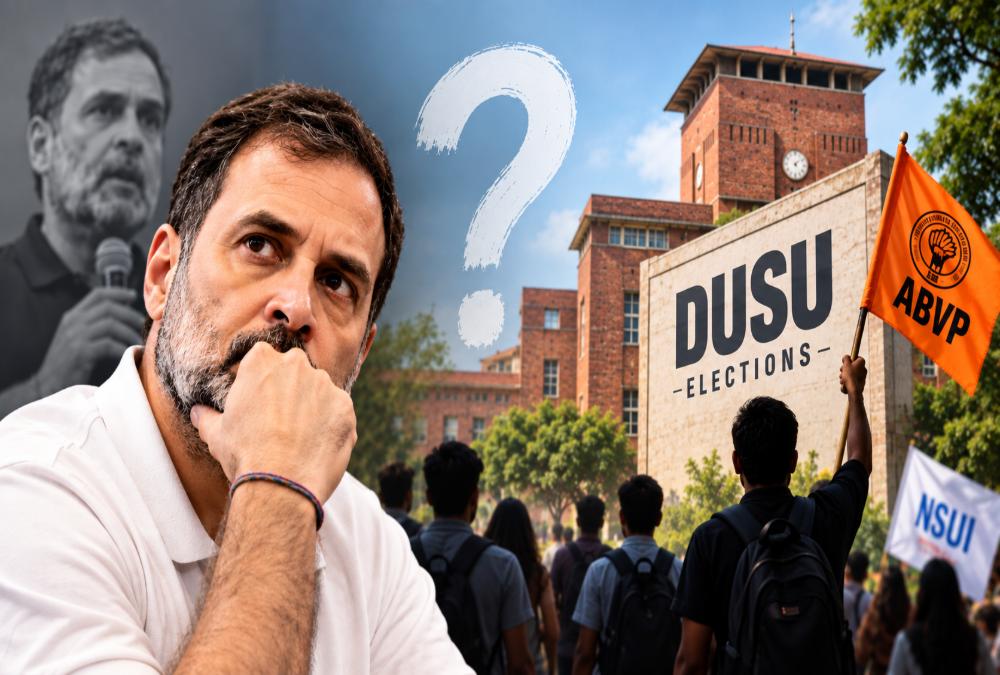

The sharpest question after the DUSU results is not whether Rahul Gandhi can draw students to an event, but whether his politics can translate into votes, organisation and sustained campus support.
At a time when Gandhi was addressing students through Chhatron Ki Goonj in Indore, the Delhi University Students’ Union election delivered an uncomfortable result for the Congress ecosystem: NSUI failed to win any of the four central-panel posts, while ABVP secured three and an independent candidate won the fourth.
That does not establish a direct causal link between Gandhi’s campaign and the DUSU outcome. But politically, the contrast is difficult to ignore.
The bigger problem is the gap between messaging and machinery. Gandhi has increasingly projected students and young people as a central constituency of his politics. Yet DUSU is precisely the kind of electoral arena where slogans have to be converted into booth-level mobilisation, candidate selection, student networks and votes.
The independent victory of Deepanshu Shokeen adds another complication. He reportedly had an earlier association with NSUI but contested independently. His 30,615 votes for Vice President show that student voters were willing to look beyond the established organisational choices.
For Congress, therefore, the DUSU result raises a pointed question: if its student organisation cannot secure even one central-panel position at one of India’s most politically visible universities, how effectively is its broader youth narrative reaching the ground?
Gandhi’s Indore programme may generate political attention, but attention and electoral organisation are two different things. The DUSU verdict puts that distinction starkly on display.
The question Rahul Gandhi now faces is simple: can “Chhatron Ki Goonj” become a student movement with electoral muscle—or remain primarily a political stage?
