
Jaishankar Says Global Order Under Stress, Calls for ‘4F’ Action
EAM highlights fuel, food, fertiliser and finance challenges, urges stronger multilateralism and institutional reform

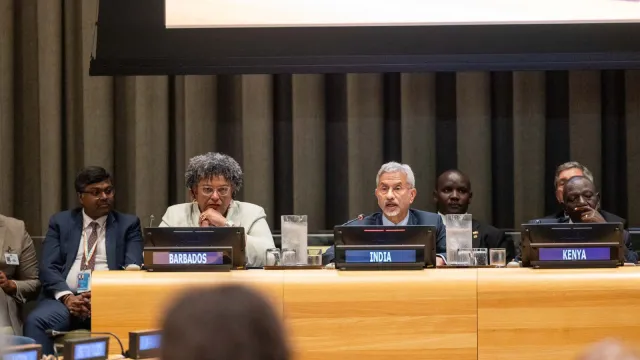
- Jaishankar flags growing geopolitical tensions and global disruptions
- Calls fuel, food, fertiliser and finance key global challenges
- Urges stronger frameworks for emerging technologies and supply chains
- Backs reformed multilateralism and transparent decision-making
By Anjali Sharma
UNITED NATIONS – Ministry of External Affairs Minister S Jaishankar on Tuesday has said the global order is under stress and that the “4F” crisis of fuel, food, fertiliser and finance cannot be left unaddressed.
He called for stronger multilateral action to tackle growing geopolitical tensions, conflicts and global disruptions.
Jaishankar spoke at the inaugural ‘Partners for Multilateralism, International Law, Peace and Prosperity (P4M) Summit’ on the sidelines of the UN High-Level Week in New York he said extreme competition, geopolitical tensions and conflicts had given a different character to the steady rebalancing of the world witnessed over the past few decades.
“If left unchecked, it would call into question the very spirit of international cooperation. And that is why it is so essential that multilateralism asserts itself strongly at this juncture,” Jaishankar said.
He said the challenges facing the international community extended beyond diplomatic rhetoric and had direct implications for global peace, security and development.
“At stake here are very real issues, not just words and expressions. The future of peace and international security, of climate action and climate justice, of emerging technologies and development finance, of countering terrorism and strengthening supply chains, and of ensuring disaster resilience and preparing for pandemics. All depend on a will to cooperate,” he said.
He emphasized that many achievements of the international system had been possible through collective efforts and called for preserving existing gains while working towards further improvements.
“Let us recognise that whatever we have achieved so far is only through collective efforts. The lesson here is to safeguard the good while striving for the better,” he said.
Jaishankar also highlighted the need for practical and targeted responses to ongoing conflicts and global disruptions rather than waiting for comprehensive solutions before addressing immediate challenges.
“That objective can be realised through a range of efforts, through a combination of initiatives. While ongoing conflicts are concerned, specific dimensions could be addressed even as we strive for a broader peace,” he said.
He also underlined the need for international frameworks to respond to emerging technologies and new capabilities, as well as measures to reduce vulnerabilities in global supply chains.
“Where new capabilities and concerns arise, there is a very powerful case for frameworks and guardrails. Where there is a threat of choke points, dominance and disruptions, de-risking and diversifying must be encouraged,” he said.
Jaishankar said countries with shared interests should have the confidence to cooperate where there was a compelling case for collective action.
He stressed that international law, rules and norms must remain central to the functioning of the multilateral system.
“Multilateralism will be best served when international law, rules and norms are scrupulously observed,” he said.
He called for institutional reform, the EAM said multilateralism would require greater advocacy as well as stronger implementation.
“For multilateralism to forge ahead, its advocacy and its practice must both be strengthened, reformed multilateralism is therefore essential,” he said.
Jaishankar called for more participatory deliberations and transparent decision-making in international institutions, saying such changes were necessary to restore confidence in the UN system.
“More participatory deliberations and more transparent decision-making are both overdue. That would provide the hope and the optimism, which is clearly needed by the UN system, and it would reinforce the resolve to work together,” he said.
The first V4+India Foreign Ministers’ Meeting was held on the margins of the 81st Session of the United Nations General Assembly in New York.
Jaishankar took part in the meeting along with Juraj Blanár, Minister of Foreign and European Affairs of the Slovak Republic; Radosław Sikorski, Deputy Prime Minister and Minister of Foreign Affairs of Poland; Petr Macinka, Deputy Prime Minister and Minister of Foreign Affairs of the Czech Republic; and Dr Anita Orbán, Deputy Prime Minister and Minister of Foreign Affairs of Hungary.
The meeting was held under the Slovak presidency of the V4, media reported.
The ministers exchanged views on ways to strengthen engagement between India and the Visegrad Group.
They acknowledged the strong bilateral relations between India and each of the V4 countries and noted the potential for the V4+India format to complement and add further momentum to these ties.
The discussions covered opportunities for cooperation in areas such as trade and investment, technology and innovation, resilient supply chains, defence and security, connectivity, education, mobility and people-to-people exchanges.
The ministers also discussed possibilities for greater interaction among businesses, academic and research institutions, and other stakeholders from India and the V4 member states.
They exchanged perspectives on global and regional developments, peace and security, and cooperation in multilateral fora.
The discussions included the need for reformed multilateralism and addressing contemporary global challenges, including those affecting the Global South.
The inaugural meeting marked an important step in establishing engagement between India and the Visegrad Group at the foreign ministers’ level.
The V4+India format offers an additional platform for dialogue and cooperation, building upon India’s longstanding and substantive relations with V4 countries.
