
BRICS Adopts Bhopal Declaration to Deepen Global Cultural Co-op
XI BRICS Culture Ministers' Meeting concludes in Bhopal with roadmap for heritage, creative economy and cultural exchange

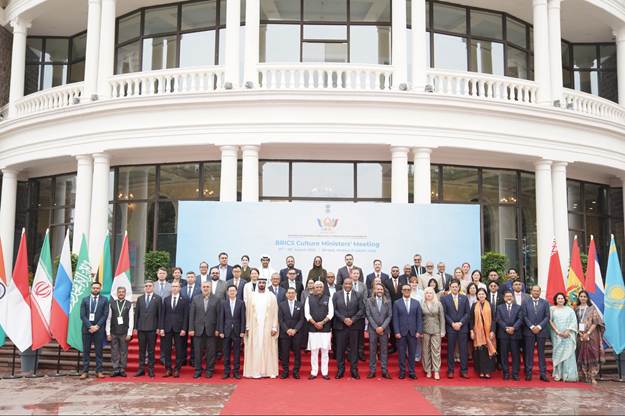
- XI BRICS Culture Ministers’ Meeting concluded in Bhopal.
- Bhopal Declaration adopted to strengthen cultural cooperation.
- India announced a voluntary BRICS Artist Registry pilot initiative.
- Ministers discussed heritage conservation, AI, museums and creative industries.
GG News Bureau
Bhopal, Aug 8: The XI BRICS Culture Ministers’ Meeting concluded in Bhopal on Saturday with the adoption of the Bhopal Declaration, setting out a practical roadmap to strengthen cultural cooperation among BRICS member states and partner countries.
Held under India’s BRICS Chairship 2026, the meeting brought together representatives from 14 countries, including all ten BRICS member nations and four partner countries. The deliberations were guided by India’s BRICS theme, “Building for Resilience, Innovation, Cooperation and Sustainability.”
The Bhopal Declaration focuses on expanding cooperation in cultural and creative industries, promoting the creative economy, encouraging exchanges of best practices, supporting creators and improving market access through digital platforms.
The declaration also calls for greater collaboration on UNESCO multinational nominations, provenance research, return and restitution of cultural property, safeguarding traditional knowledge systems, preservation of documentary heritage, digitisation of museums, libraries and archives, and ensuring fair remuneration for creators in the use of copyrighted works by Artificial Intelligence systems.
As a key outcome of the meeting, India announced a pilot Voluntary Artist Registry, aimed at facilitating cultural exchanges, strengthening professional networks and creating new opportunities for artists and creative practitioners across BRICS nations.
A major highlight of India’s BRICS Culture Track was the two-day BRICS Culture Festival held in Bhopal on August 6 and 7. The festival featured cultural performances by member and partner countries, showcasing the diversity of their artistic traditions under the theme “Sarve Bhavantu Sukhinah” (Harmony and Peace to All).
The Culture Track also included bilateral meetings between India’s Ministry of Culture and participating countries to explore avenues for deeper cultural collaboration.
Delegates were introduced to India’s rich cultural heritage through visits to the Indira Gandhi Rashtriya Manav Sangrahalaya (IGRMS) in Bhopal, while tours of Sanchi and Bhimbetka were scheduled as part of the cultural programme.
India thanked all participating BRICS member states and partner countries for their active engagement and reaffirmed its commitment to building a more connected, inclusive and future-ready cultural partnership within the BRICS framework.
