
ISRO Intensifies Space Debris Mitigation Efforts: Dr Jitendra Singh
Government advances Debris Free Space Mission, Active Debris Removal and indigenous monitoring to ensure long-term space sustainability

- ISRO is taking comprehensive measures to address rising space debris from expanding LEO satellite constellations.
- Dr Jitendra Singh says the Debris Free Space Mission will safeguard space assets through Active Debris Removal.
- India continues to strengthen global cooperation while enhancing indigenous space monitoring capabilities.
- Indian Space Policy mandates internationally recognised end-of-life disposal guidelines for satellites.
GG News Bureau
New Delhi, 13th Aug: The Indian Space Research Organisation (ISRO) is stepping up efforts to tackle the growing challenge of space debris generated by the rapid expansion of Low Earth Orbit (LEO) satellite constellations, with the Government focusing on advanced monitoring, international cooperation and indigenous technologies to ensure long-term sustainability of outer space.
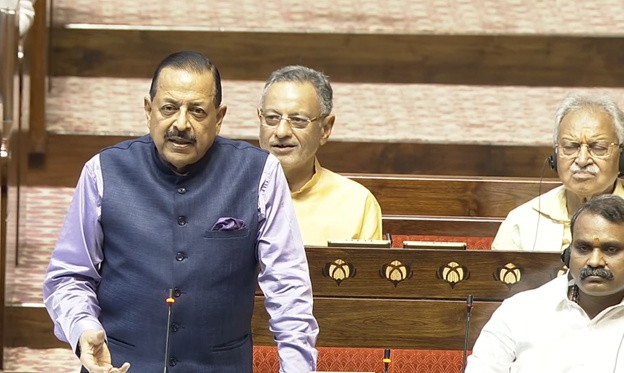
In a written reply in the Rajya Sabha on Thursday, Minister of State for Personnel, Public Grievances & Pensions and Prime Minister’s Office Dr Jitendra Singh said ISRO is fully seized of the increasing accumulation of space debris caused by large satellite internet constellations and is taking all possible measures for its mitigation and prevention.
The Minister said ISRO’s Debris Free Space Mission would play a pivotal role in protecting India’s space assets by limiting the generation of additional debris through Active Debris Removal (ADR) and other mitigation measures.
Dr Singh explained that modern satellite internet constellations typically comprise thousands of satellites, significantly increasing collision risks in crowded orbital regions. While many satellites are equipped with autonomous collision avoidance systems, failed satellites that lose manoeuvring capability continue to pose a serious threat.
He also pointed out that small, untrackable debris presents an even greater challenge because it cannot be avoided through collision avoidance or adequately shielded against. Such impacts can render satellites inoperable, create additional fragments and increase the likelihood of further collisions.
Highlighting India’s role in global efforts, Dr Singh said ISRO has been a member of the Inter-Agency Space Debris Coordination Committee (IADC) since 1996 and actively participates in international deliberations under the United Nations Committee on the Peaceful Uses of Outer Space (UN-COPUOS) on space debris mitigation and long-term sustainability.
India also contributes to discussions through the UN Scientific and Technical Subcommittee’s Working Group on Long-Term Sustainability and the Expert Group on Space Situational Awareness (SSA), besides participating in the International Academy of Astronautics Space Debris Working Group and ISO Working Group 7.
The Minister said the Indian Space Policy mandates adherence to internationally recognised space debris mitigation guidelines, including end-of-life disposal of satellites. He added that the Norms, Guidelines and Procedures issued by IN-SPACe in 2024 encourage all Indian space entities to adopt effective post-mission disposal measures or ensure satellites naturally deorbit within a limited period.
Dr Singh identified Space Situational Awareness (SSA) as one of the most critical pillars for long-term space sustainability. He said satellite operators must ensure manoeuvrability, trackability, registration of space assets and information sharing, supported by a robust regulatory framework.
He further noted that wider compliance with international debris mitigation standards and implementation of the Debris Free Space Mission would significantly reduce future debris generation. Activities serving as precursors to Active Debris Removal have already begun through on-orbit demonstrations and are expected to mature in the coming years.
Emphasising the need for both international collaboration and self-reliance, Dr Singh said India will continue to strengthen indigenous capabilities for space object monitoring while investing in research and innovation to address emerging challenges. He added that greater awareness among all space stakeholders would be essential to preserving the long-term sustainability of the space environment.
