
Rabi 2026: Chouhan Calls for Data-Driven Farm Planning
Agriculture Minister stresses water-based crop planning, timely inputs, assured procurement and weekly monitoring

GG News Bureau
New Delhi, 28th Sept: Union Agriculture and Farmers’ Welfare and Rural Development Minister Shri Shivraj Singh Chouhan has called upon States to strengthen preparations for the Rabi season through scientific assessment, data-driven planning and close field-level monitoring.
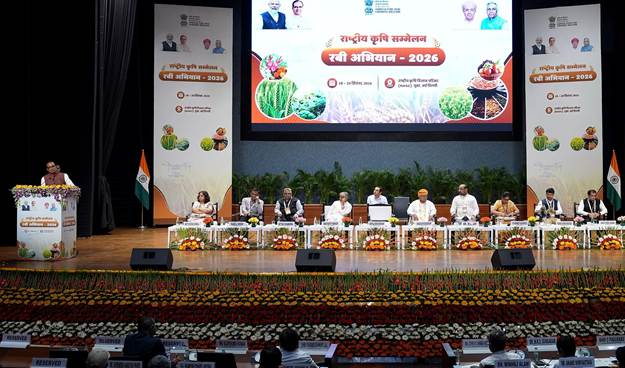
Addressing the two-day National Agriculture Conference – Rabi Campaign 2026 in New Delhi, Shri Chouhan said climate change, erratic rainfall and water constraints require stronger Centre-State coordination to protect food security and improve farmers’ incomes.
The conference, organised by the Department of Agriculture and Farmers’ Welfare at the Bharat Ratna C. Subramaniam Auditorium, NASC Complex, Pusa, brought together Union Ministers of State for Agriculture and Farmers’ Welfare Shri Ram Nath Thakur and Shri Bhagirath Choudhary, senior officials, ICAR scientists, State agriculture officials, Vice-Chancellors of agricultural universities, KVK representatives and other stakeholders.
Shri Chouhan said Rabi 2026 would be an important phase in advancing the objective of self-reliant and developed agriculture. He said the conference aims to improve Centre-State coordination, raise agricultural production and productivity, promote sustainability and develop an outcome-oriented strategy for enhancing farmers’ incomes.
Water budget to guide crop planning
Shri Chouhan identified the water budget as a key parameter for Rabi planning and asked States and districts to assess available irrigation water before finalising crop plans.
Areas with limited water availability should prioritise less water-intensive crops such as pulses and oilseeds, while areas with assured irrigation can plan other crops accordingly.
He said rainfall has remained below normal, although not to an extent that would severely affect water availability nationally. However, water shortages in some States remain a concern.
States should assess water availability and soil moisture in vulnerable areas and make arrangements for irrigation in advance.
“There should be no situation where a crop requiring more water is sown and adequate water is subsequently unavailable, resulting in crop losses,” Shri Chouhan said.
He particularly stressed careful planning in rainfed areas, where soil moisture can determine crop choice and eventual productivity.
Central teams to assess drought-hit areas
Expressing concern over drought conditions in Maharashtra and Karnataka, Shri Chouhan said nearly two-thirds of Maharashtra has been affected and the State has declared drought, while Karnataka is also experiencing drought-like conditions.
He said a Central team would undertake a ground assessment in Karnataka on October 3, while another Central team would be sent to Maharashtra.
Shri Chouhan said he would personally visit the affected States with his team and assured farmers of Central Government support.
He said Maharashtra, Karnataka, Telangana and Andhra Pradesh would require crop plans based on water availability and soil moisture, with separate strategies for rainfed and irrigated areas.
He also cautioned that delayed sowing could affect germination and productivity, making timely preparations essential.
Quality seed availability a priority
Calling seed the most critical link in Rabi preparations, Shri Chouhan asked States to immediately determine which varieties are best suited to specific regions and agro-climatic conditions.
He expressed concern that some States neither place seed demands in adequate time nor lift the required quantities, resulting in delays in distribution.
In some cases, valuable varieties reach farmers after the sowing window and are subsequently sold at prices comparable to ordinary grain.
He called for a comprehensive roadmap covering seed demand, procurement, lifting and distribution.
With ICAR scientists and agricultural experts participating in the conference, States should identify suitable varieties for different regions and conditions.
The Minister also called for an assessment of varieties released by agricultural institutions to determine which have gained adoption and which have not, followed by targeted awareness and extension efforts.
Focus on pulses and oilseeds
Shri Chouhan urged States to promote pulses and oilseeds, particularly in areas that remain fallow after paddy cultivation.
He said these crops require relatively less water and are important to the national objective of achieving self-reliance in pulses and edible oils.
States have been asked to finalise their Rabi plans by September 29, indicating the area to be brought under pulses and crops such as chana, masoor and mustard.
The Minister stressed that increased production must be accompanied by assured markets so farmers have confidence that their produce will be procured on time.
“If there are areas where nothing is grown after paddy, this is an opportunity to encourage farmers to take up pulses,” he said.
Procurement planning to accompany production
Shri Chouhan said procurement arrangements must be planned alongside production.
If State governments are unable to undertake procurement on time, Central nodal agencies NAFED and NCCF will undertake direct procurement from farmers. States, however, must provide necessary support, including timely facilitation of mandi-related requirements.
He said the Centre has approved large-scale proposals for procurement of pulses and oilseeds under the Price Support Scheme (PSS) and urged States to make full use of the mechanism.
He also pointed out that some States submit procurement proposals but subsequently do not undertake purchases.
States should therefore prepare a complete roadmap covering seed availability, distribution, production and market arrangements, he said.
Balanced fertiliser use stressed
Shri Chouhan called for greater emphasis on balanced fertiliser use, noting that excessive application can increase cultivation costs and affect soil health.
He urged States to extend the ‘Khet Bachao Abhiyan’, launched during the Kharif season, to Rabi as well.
Citing experiences in southern States where fertiliser use has declined without affecting production, he called for these practices to be shared and replicated.
He also stressed timely availability and distribution of fertilisers.
Referring to pilot initiatives based on Farmer ID, Shri Chouhan said such systems could strengthen distribution and ensure that fertilisers reach genuine farmers while preventing diversion and black marketing.
He said the Centre is currently spending around ₹2 lakh crore on fertiliser subsidy, while farmers continue to receive fertilisers at subsidised prices, including urea at ₹266 per bag and DAP at ₹1,350 per bag.
Natural farming needs stronger market support
Shri Chouhan said farmers are increasingly prepared to adopt natural farming and registration has progressed, but States must focus on branding and marketing of natural farming products.
Citing Andhra Pradesh, Gujarat and Himachal Pradesh, he said these States have developed brands and established market identities for natural farming products, helping farmers secure better prices.
He also called for certification processes that do not become barriers for farmers and for appropriate market recognition of natural products.
KCC and Farmer ID coverage to be expanded
Shri Chouhan said around 9.54 crore farmer families have been covered under PM-KISAN, but Kisan Credit Card coverage remains inadequate in several areas, particularly among small and marginal farmers.
States should identify areas where KCC coverage remains low and examine bottlenecks in loan sanctioning so farmers can access institutional credit in time.
He clarified that the objective is not to push farmers towards borrowing but to ensure that those requiring timely capital for agriculture have access to institutional credit.
On Farmer ID and AgriStack, the Minister called for faster completion of the remaining work, including land parcel-related work.
He also stressed that tenant farmers and farmers cultivating land at different locations should not be excluded from the Farmer ID framework.
Weekly crop monitoring called for
Shri Chouhan called for weekly monitoring of crop conditions, sowing progress, germination, pest and disease attacks and market prices in every State.
He said real-time information would enable authorities to identify emerging problems and take corrective action without delay.
The Agriculture Department and relevant agencies should maintain close field-level surveillance, he said.
The Ministry also conducts weekly national reviews covering crop conditions, market rates and disease outbreaks to facilitate timely intervention.
ICAR stresses climate-resilient agriculture
Secretary, Department of Agriculture and Farmers’ Welfare, Shri Atish Chandra, said changing weather patterns, uneven rainfall and moisture-related challenges in rainfed areas underline the need for agricultural diversification, sustainable farming and research-based practices.
He stressed the importance of initiatives such as Per Drop More Crop, soil health management, modern agricultural infrastructure, market mechanisms and digital agriculture solutions.
Secretary, DARE and Director General, ICAR, Dr. Mangi Lal Jat, identified self-reliance, crop diversification, climate-resilient agriculture, digital agriculture and risk mitigation as key priorities for the Rabi campaign.
He emphasised oilseed and pulse production, particularly through crop diversification in rice-fallow areas.
Dr. Jat said this would require a comprehensive technological package covering crop and variety selection, quality seeds, mechanisation, biological solutions and seed treatment.
He also informed that large-scale demonstrations of green ammonia are planned across 10,000 acres in 37 districts of six States during the upcoming season.
Two-day conference to shape Rabi action plan
The two-day National Agriculture Conference brings together senior officials from the Centre and States, ICAR scientists and Agriculture Ministry teams.
The first day will feature thematic discussions on self-reliance and diversification; sustainability and climate-resilient agriculture; and digital agriculture, infrastructure, financing and risk management.
On September 29, Shri Chouhan will hold discussions with Agriculture Ministers of the States on the weather outlook for Rabi, fertiliser availability, the Digital Agriculture Mission, Farmer Registry, missions on pulses and edible oils, PM Dhan-Dhaanya Krishi Yojana, marketing reforms and planning through ATMA and KVKs.
The concluding session will consolidate the discussions and prepare an action plan for increasing Rabi production, empowering farmers and advancing the objective of self-reliant agriculture.
