
“We Will Uproot the Drug Trade by 2029”: HM Amit Shah
Home Minister calls for a mission-driven approach to dismantle drug networks, strengthen ANTFs and protect India’s youth

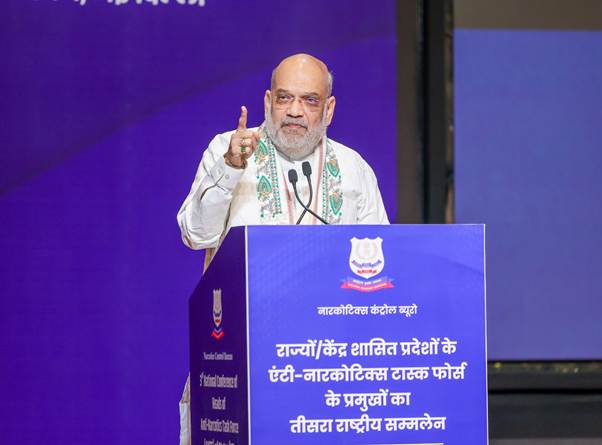
- Amit Shah sets a 2029 roadmap for a drug-free India.
- ANTFs urged to shift from seizures to network dismantling.
- 10 lakh institutions to be covered by Nashamukt Mitras.
- New NCB complexes planned in Lucknow and Dehradun.
GG News Bureau
New Delhi, 22nd Sept: Union Home Minister and Minister of Cooperation Amit Shah on Tuesday inaugurated the 3rd National Conference of Anti-Narcotics Task Force (ANTF) Heads of States and Union Territories in New Delhi, calling for a coordinated and decisive approach to eliminate the drug trade from India by 2029.
Addressing the two-day conference organised by the Narcotics Control Bureau (NCB), Shah said the fight against narcotics must become a national priority, with clear targets, timelines and accountability. He said the roadmap for a drug-free India is critical to achieving Prime Minister Narendra Modi’s vision of a Viksit Bharat by 2047.
Shah said the country must move from “Meeting to Mission, Reporting to Result, Seizure to End of Network and Case to Conviction.” He called for transforming the ANTF into an “Anti-Narco Mission Command” and shifting the focus from seizures to dismantling entire drug networks.
2029 roadmap for drug-free India
The Home Minister said the Vision Document 2026–2029, prepared after consultations with more than 35 departments, provides a roadmap with defined targets and timelines. The document rests on four strategic pillars: enforcement, intelligence and operations; control of precursor and synthetic drugs; demand and harm reduction; and capacity building and coordination.
He said India must ensure that not even a single gram of narcotics enters or leaves the country, while stressing that the fight must be pursued with compassion and a focus on protecting young people.
Districts to become key units
Shah called for making districts the basic units of the anti-drug campaign. Districts will be categorised into three groups — drug manufacturing or entry points, transportation corridors and consumption districts.
He also called for targeting drug cartels at three levels: entry points, interstate distribution systems and local networks operating within districts.
Financial investigations and the tracing of digital links, alongside backward and forward investigations, were identified as priorities. Shah also highlighted emerging challenges involving synthetic drugs, precursor chemicals, darknet markets, cryptocurrencies and new communication technologies.
10 lakh institutions to be covered
The Home Minister said the Nashamukt Mitra initiative would be expanded to schools, colleges and other institutions across the country. According to the government, 46,780 Nashamukt Mitras have already been registered against a target of one lakh.
He said these volunteers would visit 10 lakh schools, colleges and institutions to raise awareness among young people and sensitise campus authorities.
Focus on international networks and convictions
Shah called for greater use of financial investigations and stronger coordination between investigators and prosecutors to improve the journey from investigation to conviction.
He also called for campaigns to deport and blacklist foreign accused persons involved in drug trafficking and for fugitives supplying narcotics to India from abroad to be brought before Indian courts.
NCB infrastructure and awareness initiatives
During the conference, Shah launched television commercials for anti-narcotics awareness, the newly redesigned NCB website and laid the foundation stones for new NCB zonal complexes in Lucknow and Dehradun. The best-performing ANTFs of States and Union Territories were also honoured.
Heads of ANTFs from 36 States and Union Territories, along with representatives of government departments and other stakeholders, are participating in the conference. The deliberations are aimed at strengthening coordination between the NCB and State/UT ANTFs under a whole-of-government approach.
